
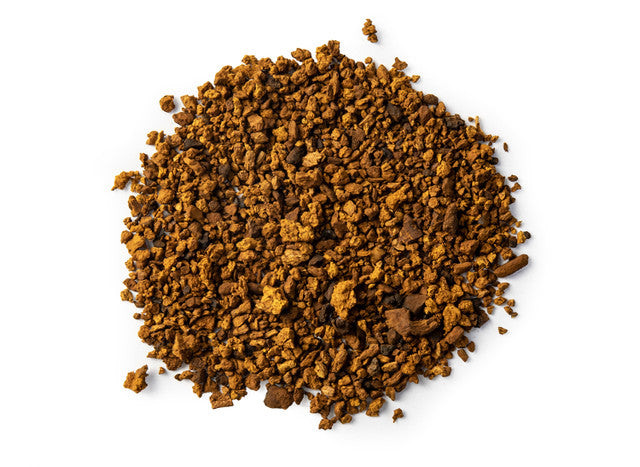
Chaga Mushroom Powder
Chaga Mushroom Powder is ground chaga harvested from birch trees in remote forest regions and prepared carefully to keep its natural qualities intact. Milling the hard conk into powder lets it disperse into a smoothie, a tonic or a quick pot of tea without a long simmer. It is offered in 4oz, 1LB and 10lb sizes.
At a glance
- Whole ground chaga, not a standardized extract
- Harvested from birch trees in remote forest regions
- Carries polyphenols, melanin, beta-glucans and betulinic acid
- Tea: 1 to 2 teaspoons per 8 oz hot water, steeped 5 to 10 minutes
- Grounding, earthy, faintly vanilla character
- Offered in 4oz, 1LB and 10lb sizes
The herb. Chaga (Inonotus obliquus, Hymenochaetaceae family) grows as a black, cracked mass on living birch trunks in the cold forests of Siberia, northern Europe and Canada. The dark exterior is loaded with melanin, and the golden interior holds beta-glucans, polyphenols and betulinic acid, a compound the fungus builds from the betulin in birch bark. Siberian villagers have grated and brewed it as an everyday tea for centuries.
What's in it. This is whole ground chaga, not a standardized extract, so no percentages are claimed. The powder carries the natural antioxidant polyphenols and melanin that give chaga its dark color, the beta-glucans in its cell walls, and betulinic acid from its birch host.
Dosage, first time. For a tea, the standard herbal preparation is 1 to 2 teaspoons per 8 oz of hot water, steeped 5 to 10 minutes, though chaga gives more when simmered gently. For smoothies and tonics, start with a small amount and see how it sits with you.
Regular use. Most people work chaga into one daily cup or blend and keep it there. Because it is a whole powder it does not fully dissolve, so stir well and expect some sediment.
What to expect. A mild, earthy, faintly vanilla-like taste with gentle bitterness that pairs naturally with coffee, cacao or honey. Users describe chaga as grounding and easygoing. For a concentrated small-serving format see our Chaga Extract, and for a slow-simmered decoction from intact pieces see our Chaga Chunks.
Side effects. Chaga is well tolerated by most people, though some notice mild digestive upset when they first add it. Reduce the amount or take it with food, and stop if it continues. Not for anyone with a mushroom allergy.
Interactions and cautions.
- Naturally high in oxalates, so talk to your provider before regular use if you have a history of kidney stones
- Consult a healthcare professional before use if you are pregnant, nursing, on medication, or preparing for surgery
Ingredients and storage. Chaga Mushroom (Inonotus obliquus). Store sealed in a cool, dry place away from direct sunlight.
Common questions
- Can I brew Chaga Mushroom Powder as a tea? Yes, steep or gently simmer it in hot water and let the sediment settle.
- What is the difference between chaga powder and chaga chunks? Powder disperses into smoothies and quick brews, while chunks need a long simmer and can be reused for several pots.
- Does chaga powder taste like coffee? It is mild, earthy and slightly vanilla.
Disclaimer. These statements have not been evaluated by the Food and Drug Administration. This product is not intended to diagnose, treat, cure, or prevent any disease. Chaga is a traditional botanical, and traditional use does not establish that it will produce any particular result. Consult your healthcare provider before use if you take any medication or have a medical condition. Use at your own risk and keep out of reach of children. Formulated by Healing Herbals, run by a practicing herbalist of 13+ years.
Choose options