
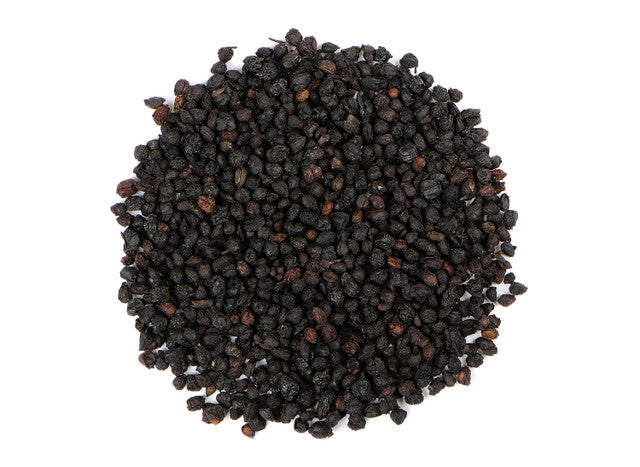
Organic Elder Berries
Organic Elder Berries are organic dried elder berries from Sambucus nigra, a deep purple-black fruit for tea, syrup or your own recipes. One point matters first: elder berries must be cooked before use, since raw or undercooked berries are not safe to eat. Offered in 4oz, 1LB and 10lb sizes.
At a glance
- Whole dried Sambucus nigra fruit for tea, syrup and home recipes
- Must be cooked before use; raw or undercooked berries are not safe to eat
- Rich in anthocyanins (cyanidin glycosides), with quercetin, rutin and vitamin C
- Tea: 1 to 2 teaspoons per 8 oz, simmered 10 to 15 minutes
- Offered in 4oz, 1LB and 10lb sizes
The herb. Elder (Sambucus nigra) is a fast-growing shrub or small tree of the Adoxaceae family, native to Europe, western Asia and North Africa. Its berries were traditionally made into wines, jams and winter syrups, and the fruit is rich in anthocyanins, the pigments behind its wine-dark color.
What's in it. A dense natural mix, not a standardized extract, so no percentage is quoted. Anthocyanins (mainly cyanidin glycosides) give the color, with quercetin, rutin, organic acids, natural sugars, pectin and small amounts of vitamin C and minerals. The raw berry, seeds, stems and leaves also hold cyanogenic glycosides such as sambunigrin and lectins, so cooking is required to break these down.
How to use. Use 1 to 2 teaspoons of dried berries per 8 oz of water. Because they must be cooked, bring them to a gentle simmer in a covered pot for 10 to 15 minutes, then strain and sweeten with honey if you like. Most households use it as a daily winter tea or a spoonful of syrup; keep to cooked preparations and discard any stems.
What to expect. Flavor first: dark, tart and fruity, more like a dry red wine than a sweet berry. It is a food and tea herb, not a concentrated extract, and never eaten raw from the bag.
Safety. Properly cooked elderberries are gentle. Raw or undercooked berries, and any leaves, stems, bark or seeds, can cause nausea, vomiting, stomach cramps and diarrhea; even cooked, very large amounts can loosen the bowels. Consult a healthcare professional before use if you are pregnant, nursing, taking any medication or managing a medical condition, and before giving elderberry to children. Use only cooked preparations.
Ingredients and storage. Elder Berries (Sambucus nigra), organic, dried whole. Store airtight in a cool, dark, dry place, and refrigerate finished syrups.
Common questions
- Can you eat dried elder berries raw? No, they must be cooked; raw or undercooked berries can cause nausea, vomiting and stomach cramps.
- How long should I simmer dried elderberries for tea? Simmer 1 to 2 teaspoons of berries per 8 oz of water in a covered pot for 10 to 15 minutes, then strain well.
Disclaimer. These statements have not been evaluated by the Food and Drug Administration. This product is not intended to diagnose, treat, cure, or prevent any disease. Elderberry is a traditional botanical, and traditional use does not establish that it will produce any particular result. Consult your healthcare provider before use if you take any medication or have a medical condition. Use at your own risk and keep out of reach of children. Formulated by Healing Herbals, run by a practicing herbalist of 13+ years.
Choose options