
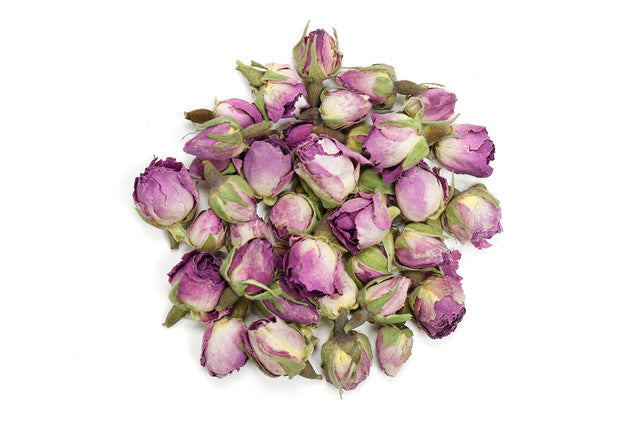
Whole Rose Buds
Whole Rose Buds are whole dried buds of Rosa species, picked before they open and dried slowly to keep their shape, color and scent. Use them for a perfumed tea, a handful in a warm bath, or a floral touch in DIY skin care. Offered in 4oz, 1LB and 10lb sizes.
At a glance
- Whole dried Rosa buds, dried slowly to keep shape, color and scent
- Volatile oil of citronellol, geraniol and nerol, plus tannins and flavonoids
- Tea: 1 to 2 teaspoons, about five or six buds, steeped 5 to 10 minutes
- Caffeine-free and mild
- Offered in 4oz, 1LB and 10lb sizes
The herb. Roses belong to the Rosaceae family, alongside apples and almonds, and dried buds come mostly from Rosa damascena, Rosa centifolia and Rosa rugosa, grown across Persia, Bulgaria, Morocco and China. Rose has been steeped, distilled into rose water and candied for over a thousand years. The buds carry a volatile oil of citronellol, geraniol and nerol, plus tannins and flavonoids, and the cup is caffeine-free and mild.
How to use. Drop 1 to 2 teaspoons of buds, about five or six, into a cup of hot water and steep 5 to 10 minutes. Start with fewer buds, since rose is easy to overdo. For a bath, a small handful under the running tap is enough for a whole tub; in skin care, a tablespoon of buds infused into a carrier oil is a usual starting point.
What to expect. A soft, fragrant cup, calming without heaviness, made for a slow morning or a bath night. For a floral blend, it pairs naturally with our Lavender Flower (Organic).
Safety. Rose is one of the mildest botanicals we carry. A very strong cup can feel astringent on the stomach, and sensitive skin occasionally reacts to a long soak; use fewer buds or a shorter soak. No notable interactions are documented at tea strength. Consult a healthcare professional before use if you are pregnant, nursing or on medication, and patch-test any homemade skin care recipe first.
Storage. Whole Rose Buds (Rosa spp.). Keep sealed in a cool, dark, dry cupboard, since the buds fade in sunlight and lose scent if left open.
Common questions
- How many whole rose buds do I use for one cup of tea? About five or six buds, roughly 1 to 2 teaspoons, steeped 5 to 10 minutes.
- Can whole rose buds go straight into the bath? Yes, either loose or in a muslin bag, and the bag makes cleanup easier.
Disclaimer. These statements have not been evaluated by the Food and Drug Administration. This product is not intended to diagnose, treat, cure, or prevent any disease. Rose is a traditional botanical, and traditional use does not establish that it will produce any particular result. Consult your healthcare provider before use if you take any medication or have a medical condition. Use at your own risk and keep out of reach of children. Formulated by Healing Herbals, run by a practicing herbalist of 13+ years.
Choose options