
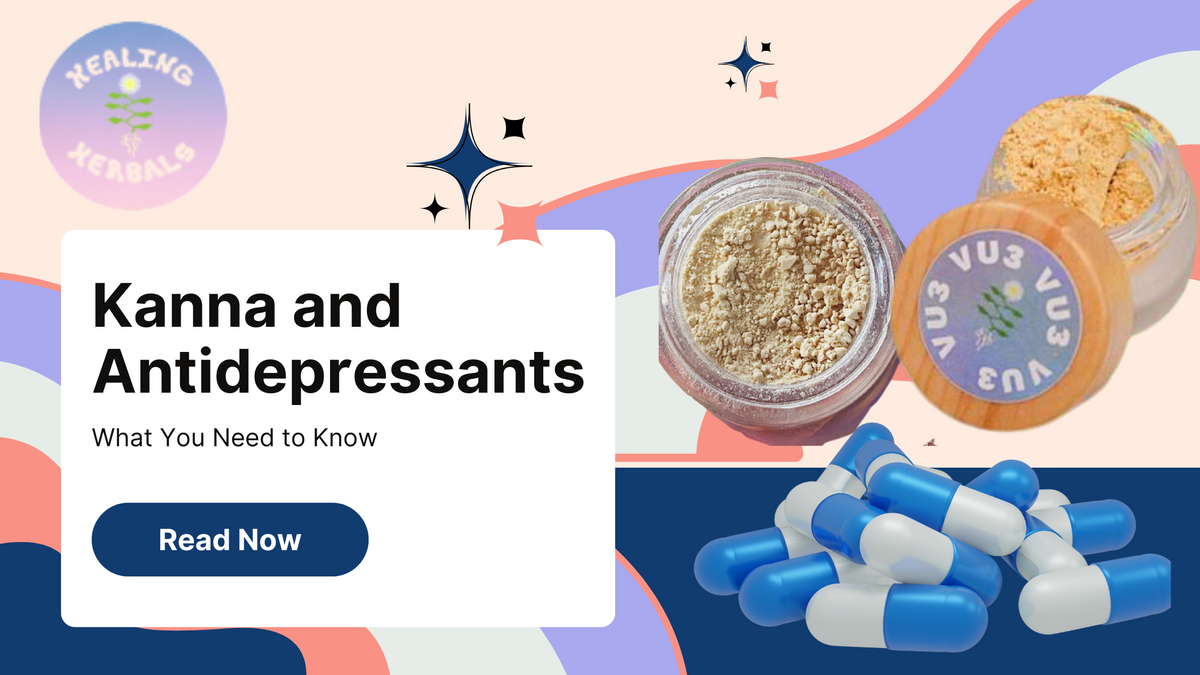
Kanna and Antidepressants: What You Need to Know
TL;DR: If you take an antidepressant or any other prescription, don't add kanna (or any botanical) until you've talked to your doctor or pharmacist. Kanna's alkaloids act on some of the same pathways as mood medications, and whenever two things do that, an interaction is possible. Botanicals aren't medicine and aren't a substitute for medical care, so when in doubt, ask first.
Why professional guidance matters when botanicals and prescriptions share the same space.
Mixing herbs and prescription medication is never something to take casually. Kanna (Sceletium tortuosum) is a South African succulent with a long history of traditional use, and "can I take it with my meds?" is one of the most common questions we get, at the counter, over the phone and in our inbox. The honest answer: that's a conversation for your doctor, not a blog post. Here's why we say that, and how to have the conversation.
Why caution matters
Researchers have studied the alkaloids in Sceletium tortuosum, mainly mesembrine and mesembrenone, for how they act in the body. Mesembrine in particular is known for its effect on serotonin reuptake. A lot of common antidepressants work on serotonin too.
Whenever two substances act on similar pathways, there's potential for an interaction. That isn't unique to kanna. It's true of plenty of botanicals and even everyday foods. Grapefruit famously interacts with a long list of medications, and St. John's Wort is known for interacting with many prescriptions. Kanna belongs in that "check first" category.
Our guidance, plain and simple
If you take any prescription medication, including medication for mood or any chronic condition, do not add any botanical supplement to your routine without first speaking with your doctor or pharmacist. They can look at your full medication list and your health history and give you advice that's specific to you.
We'd rather lose a sale than have someone mix something they shouldn't. That's not us being dramatic. It's just what being a responsible shop looks like after 13 years of doing this.
How to have the conversation with your doctor
A lot of people feel awkward bringing up herbs with their doctor. Don't. Pharmacists in particular deal with these questions all the time, and they'd much rather hear it from you than find out later.
A few things make it easier. Bring the actual product or a photo of the label so they can see exactly what it is. Write down every medication and supplement you take, including over-the-counter stuff. Mention the botanical name, Sceletium tortuosum, since some references list it that way instead of "kanna." And be honest about how much you were planning to take and how often.
Don't stop or change your meds on your own
This one matters. Please don't stop, lower or swap out a prescription because you read about a plant online, including anything on our site. Changes to mood medications in particular should always be made with your prescriber. Coming off some medications too quickly can cause real problems of its own.
What we tell people at the counter
When someone tells us they're on medication and wants kanna anyway, we don't sell them a bag and wish them luck. We tell them to check with their prescriber first and come back. Plenty do. Some find out it's fine for them, some find out it isn't, and either way they leave knowing more than when they walked in.
The bottom line
Botanical products are not medicines and they're not a substitute for medical care. Being a responsible botanical retailer means saying it clearly: when in doubt, ask your healthcare provider first.
Common questions
Can I take kanna if I'm on an antidepressant?
Talk to your doctor or pharmacist before you do. Kanna and many antidepressants both act on serotonin, so an interaction is possible.
Is kanna the only herb that interacts with medications?
No. Many botanicals and some foods, like grapefruit, can interact with prescriptions. St. John's Wort is one of the best-known examples.
What should I bring to my appointment?
The product or its label, a full list of everything you take, and how much you planned to use.
Ask first, every time. It's a two-minute conversation that can save you a lot of trouble.
This article is for informational purposes only and is not medical advice. These statements have not been evaluated by the Food and Drug Administration. Our products are not intended to diagnose, treat, cure, or prevent any disease.

Written by Herbal Healings

%20until%20you've%20talked%20to%20your%20doctor%20or%20pharmacist.%20Kanna's%20alkaloids%20act%20on%20some%20of%20the%20same%20pathwa...)
Leave a comment
This site is protected by hCaptcha and the hCaptcha Privacy Policy and Terms of Service apply.