
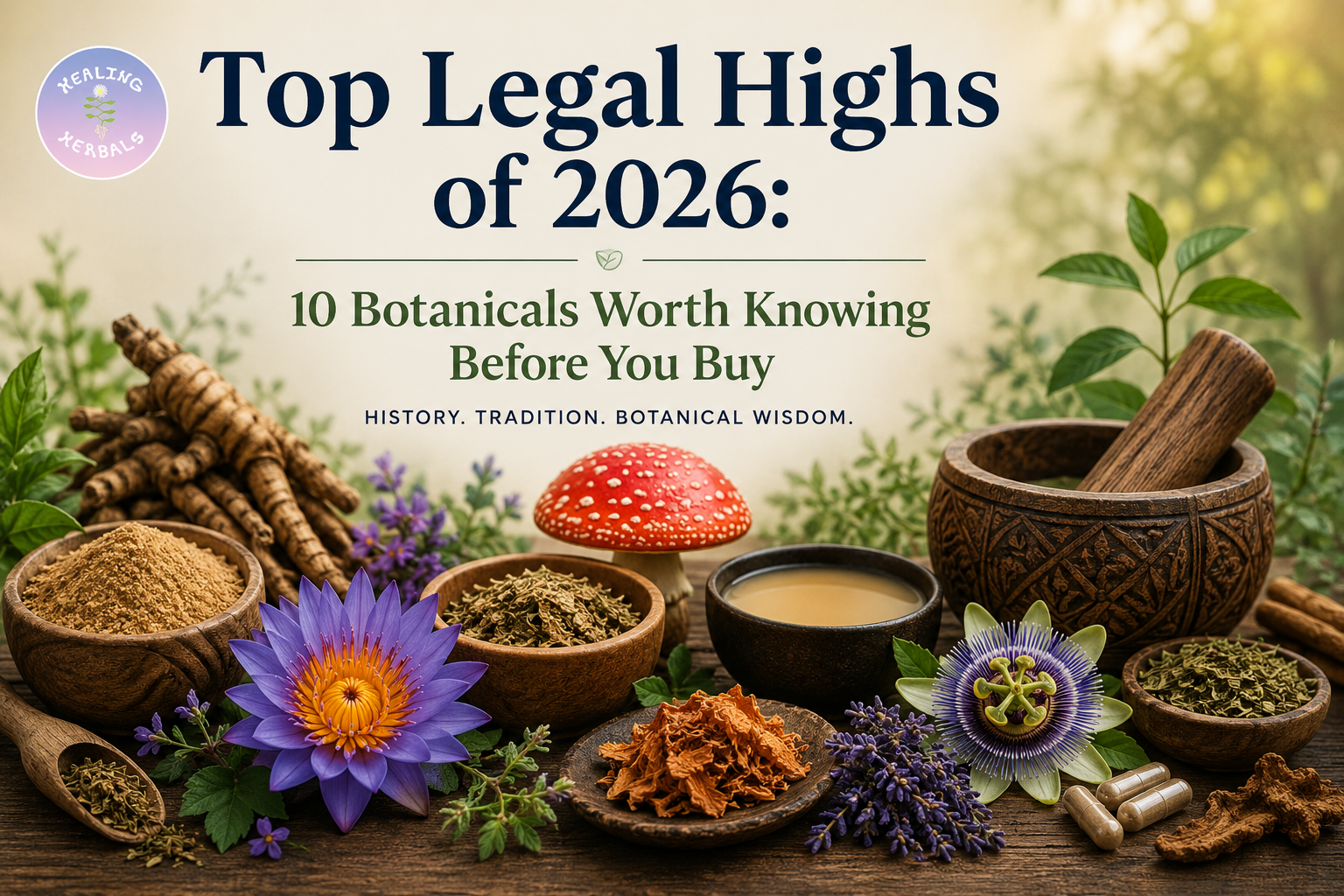
Top Legal Highs of 2026: 10 Botanicals Worth Knowing Before You Buy
The botanical market has changed considerably in the last five years. Plants that once circulated quietly among ethnobotanical enthusiasts and a small number of specialty importers Kanna, Blue Lotus, Wild Dagga are now standard inventory at kava bars, wellness retailers, and botanical shops across the country.
That growth has brought a genuine upside: greater access, more available information, and a public far more literate in these plants' histories than a decade ago. Understanding a plant's traditional preparation, its documented history, and how its active compounds vary naturally from one specimen to the next is what turns casual interest into real botanical literacy.
What follows is a working reference for ten botanicals that merit a place on any credible list of the top legal highs of 2026. None of them are included because they are trending. Each has a documented history, an established community of knowledgeable users, and a legitimate place in today's herbal market.
A quick note before you dive in: "legal" is a moving target. Regulations on these plants vary by state, country, and sometimes even by city, and laws are actively evolving as these botanicals grow in popularity. Always check your local regulations before purchasing, and treat anything you read here including this post as botanical and cultural education, not medical or legal advice.
1. Kanna (Sceletium tortuosum)

No botanical has reshaped this market quite like Kanna. Native to South Africa, it was traditionally harvested and fermented by the Khoisan people long before anyone thought to standardize it into a capsule. That fermentation step isn't a historical footnote it's central to how the plant has always been prepared, and it still shapes quality today.
Modern Kanna comes in nearly every format imaginable: powders, tinctures, gummies, resin, nasal sprays, and highly refined extracts. One detail that often surprises newcomers is that Kanna's alkaloid profile particularly the ratio of mesembrine to mesembrenone occurs naturally and can vary depending on the plant's growing conditions and how it was processed. Enthusiasts who study the plant closely tend to pay attention to this chemistry as much as they do the overall potency.
Common forms: standardized extracts, traditional fermented herb, gummies, capsules, tinctures, nasal sprays, resin
2. Kava (Piper methysticum)

Long before "kava bar" became a phrase you'd see on a strip mall sign in the U.S., kava was already the social glue of the South Pacific. In Vanuatu, Fiji, Tonga, and Samoa, preparing kava was never just about the drink it was, and still is, a ritual built around hospitality and community.
Traditional preparation involves grinding fresh or dried kava root and mixing it with water, strained and served communally. Modern convenience has given us instant powders and ready-to-mix pouches, but the cultural weight behind the plant hasn't diminished if anything, it's part of what draws people to it.
Common forms: traditional root powder, instant kava, micronized kava, liquid tinctures, gummies, drink mixes
3. Blue Lotus (Nymphaea caerulea)

Few flowers carry the visual history that Blue Lotus does. It shows up in Egyptian temple carvings and ceremonial artwork dating back thousands of years, making it one of the oldest documented botanicals still sold today.
Its recent popularity has also led to some naming confusion. The common name "Blue Lotus" is sometimes used for other ornamental water lily species that are botanically distinct from Nymphaea caerulea, which is why the Latin binomial is worth knowing when researching the plant.
Common forms: whole flowers, dried petals, loose-leaf tea, resin, standardized extracts, gummies
4. Amanita muscaria

That bright red cap with white spots has been part of folklore and fairy-tale imagery for centuries, so it's no surprise Amanita muscaria has found its way into the botanical mainstream. It's also one of the more technically demanding plants on this list unlike culinary mushrooms, Amanita requires specific processing before it can be used, a practice with its own history in the regions where the mushroom traditionally grows.
Common forms: dried caps, powder, standardized extracts, capsules, gummies
5. Damiana (Turnera diffusa)
 Damiana has quietly held its place in Mexican, Central American, and Caribbean herbal traditions for generations, brewed most often as a fragrant tea. Unlike some of the plants on this list, it didn't need a social media moment to build its following it's been a steady favorite among people who appreciate classic, well-documented botanicals.
It's a relatively easy plant to cultivate, and its leaves are traditionally harvested and dried before being brewed, a process that has changed very little over generations.
Common forms: loose-leaf herb, herbal tea, capsules, liquid tinctures, botanical smoking blends
6. Wild Dagga (Leonotis leonurus)

With its striking orange, tiered flower spikes, Wild Dagga sometimes called Lion's Tail is nearly impossible to mistake for anything else. Native to southern Africa, both the flowers and leaves have traditional uses, though collectors tend to gravitate toward the vivid blossoms.
Common forms: dried flowers, loose herb, resin, botanical blends
7. Passionflower (Passiflora incarnata)

Passionflower's intricate purple-and-white blossoms get all the attention, but it's actually the leaves and stems the aerial parts that show up in most herbal preparations. Native to North America, this climbing vine has centuries of traditional use behind it and remains a staple in herbal collections that lean toward classic, time-tested botanicals.
Common forms: loose-leaf tea, capsules, liquid tinctures, powder, herbal blends
8. Skullcap (Scutellaria lateriflora)

Skullcap isn't a trend chaser it's one of those Western herbal staples that's simply never gone out of style. Harvested from the aerial portions of the plant before flowering, it has a long track record in Western herbal traditions.
Worth noting: several plant species share the common name "skullcap," so Scutellaria lateriflora refers to the specific species with this documented traditional history.
Common forms: loose herb, tea, capsules, powder, tinctures
9. Blue Vervain (Verbena hastata)

This North American native wildflower, with its tall spikes of violet-blue blooms, grows naturally in wetlands and meadows across the eastern U.S. It's carved out a loyal following among people drawn specifically to native American botanicals with documented traditional use.
Common forms: loose herb, herbal tea, capsules, tinctures, powder
10. Calea zacatechichi

It doesn't get the spotlight that Kanna or Kava does, but Calea zacatechichi has a devoted following among serious ethnobotanical collectors. Native to Mexico and Central America, it's been prepared as a tea for generations and is instantly recognizable by its distinctively bitter flavor a trait long-time users consider part of the plant's traditional character rather than a flaw.
Common forms: loose leaf, tea, powder, capsules, standardized extracts
Why the History Behind These Plants Actually Matters
It's easy to treat this list as a simple catalog and stop there. But every one of these botanicals has a life that predates its current visibility by decades, sometimes millennia. Kava has anchored community gatherings across the South Pacific for generations. Kanna carries the fermentation knowledge of the Khoisan people. Blue Lotus appears in Egyptian art thousands of years old.
Understanding that context adds real depth to how these plants are appreciated today. These botanicals are more than entries on a list they're living threads connecting current interest to centuries of cultural practice.
Final Thoughts
The growing interest in legal botanical alternatives has opened the door to plants that used to live in the margins of herbal culture. That visibility is a meaningful shift, and it comes with an opportunity: the more people understand a plant's history, traditional preparation, and botanical identity, the more informed their appreciation of it becomes.
The plants on this list have endured on their own merit for generations, long before they had any market presence at all. Learning their history is, in many ways, the most valuable thing a curious reader can take from a list like this one.
This article is intended for general educational and cultural interest purposes only. It does not constitute medical, health, or legal advice. Regulations on these botanicals vary by state and country and are subject to change — always verify current local laws before purchasing or using any of the plants discussed above.

Written by Herbal Healings

Leave a comment
This site is protected by hCaptcha and the hCaptcha Privacy Policy and Terms of Service apply.