Amanita Extract Partially Decarboxylated
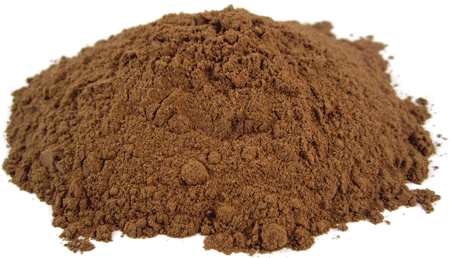
Amanita Extract Partially Decarboxylated is a concentrated extract of Amanita muscaria that has been taken through a controlled partial decarboxylation, a heating step that converts some of the mushroom's ibotenic acid into muscimol while leaving the rest of its natural compound profile in place. The conversion is stopped part way, so the finished material carries both compounds in a balance a fully converted extract does not. It is manufactured under strict quality control guidelines and arrives as either a powder or a resin. It is not intended for human consumption and is not available in Louisiana.
At a glance
- Concentrated Amanita muscaria extract taken through a controlled partial decarboxylation
- Converts some ibotenic acid into muscimol while leaving the rest of the profile in place, so both compounds remain
- Manufactured under strict quality control guidelines
- Arrives as either a powder or a resin
- Offered in 1g, 2g, 5g, 10g, 20g, 50g and 100g sizes for scientific investigation, academic research and botanical reference
- Not for human consumption; not available in Louisiana
The herb. Fly agaric (Amanita muscaria) is the red-capped, white-flecked mushroom of the northern forests, growing with birch, pine and spruce across Europe, Siberia and North America. It holds a real place in the folk practices of the Koryak of Kamchatka and the Sámi of northern Scandinavia, who dried it carefully before any use. Two related compounds define it: ibotenic acid, which the fresh mushroom mostly contains, and muscimol, which forms when ibotenic acid loses a carboxyl group under heat or slow drying. The ratio between them is what separates one preparation from another, and why processing matters more with amanita than with almost any other botanical.
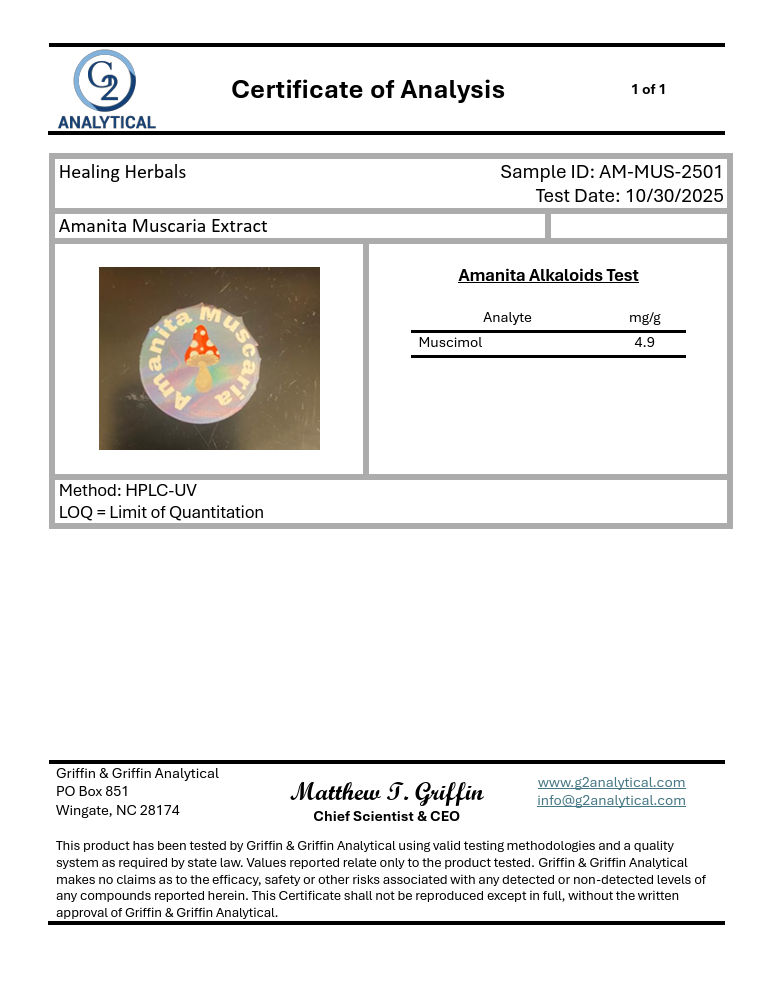
Active content. This extract is defined by its process rather than by a stated percentage: a controlled partial decarboxylation that converts a portion of the ibotenic acid into muscimol while preserving the essential natural compounds of the mushroom. We do not publish a muscimol figure for it, so consider it a mixed-profile material:
- Muscimol: the compound ethnomycology literature associates with a calm, dreamy, body-heavy character
- Ibotenic acid: the sharper precursor that accounts for much of the nausea in poorly prepared mushroom
Keeping some of both, this extract sits between raw dried caps and our fully converted Amanita Extract 15:1 High Muscimol.
Dosage, first time. This extract is sold as research and reference material, not as a food or supplement, and we do not give a serving for it. Anyone handling amanita should follow the rule every tradition arrived at on its own: begin with a tiny amount, far less than seems reasonable, and wait several hours before judging, because both compounds come on slowly and unevenly. Never work with fresh or unprepared caps. An extract is stronger by weight than dried mushroom, so the margin for error is smaller, not larger.
Regular use. There is no stated range for this product, so consistency comes from handling, not escalation. Weigh rather than eyeball, log how each batch looks and behaves, and remember that resin and powder from the same run differ in density. Amanita compounds are not daily-use material in any tradition, and spacing sessions well apart is the norm.
What to expect. Researchers and collectors choose the partially decarboxylated extract when they want the mushroom's fuller compound spectrum in a concentrated, low-bulk form. Users describe muscimol-forward preparations as calm, heavy, dreamy and inward, while ibotenic-acid-forward material reads as edgier and more restless; a partial conversion lands between the two. It is not a bright, social or energizing botanical, and not a beginner's material. For whole dried caps, see our Amanita Muscaria Mushroom Caps (A-Grade).
Side effects. Amanita is strongly dose-related, and the unpleasant effects arrive first when too much is used. Nausea, sweating, heavy salivation, drowsiness and unusually vivid dreams are the classic ones, and the ibotenic acid retained in a partial extract makes nausea more likely than with fully converted material. Reduce the amount or stop entirely if any of these appear. Fresh or unprepared caps are never acceptable.
Interactions and cautions.
- Do not combine amanita material with alcohol, sedatives or any medication
- Not for use if pregnant or nursing
- Muscimol and ibotenic acid affect dogs and cats badly, so keep this extract sealed and well away from pets
- Amanita law varies by state and country; this product cannot ship to Louisiana, and it is your responsibility to check the rules where you live
- For adults 21+ only; keep out of reach of children
Ingredients and storage. Partially decarboxylated Amanita muscaria extract, powder or resin. Store sealed in a cool, dry place away from direct sunlight; resin softens in heat and firms again when cooled.
Common questions
- What does partially decarboxylated mean on this Amanita extract? It means the extract was heated enough to convert some, but not all, of its ibotenic acid into muscimol, so both compounds remain.
- Is the Amanita Extract Partially Decarboxylated a powder or a resin? Either, depending on the batch and shipping conditions, and the material is the same.
- Can I order the partially decarboxylated Amanita extract in Louisiana? No, it is not available for shipment to Louisiana.
Disclaimer. These statements have not been evaluated by the Food and Drug Administration. This product is not intended for human consumption and is not intended to diagnose, treat, cure, or prevent any disease. Amanita is a traditional botanical, and traditional use does not establish that it will produce any particular result. Consult your healthcare provider before use if you take any medication or have a medical condition. Use at your own risk and keep out of reach of children. Formulated by Healing Herbals, run by a practicing herbalist of 13+ years.
Choose options