
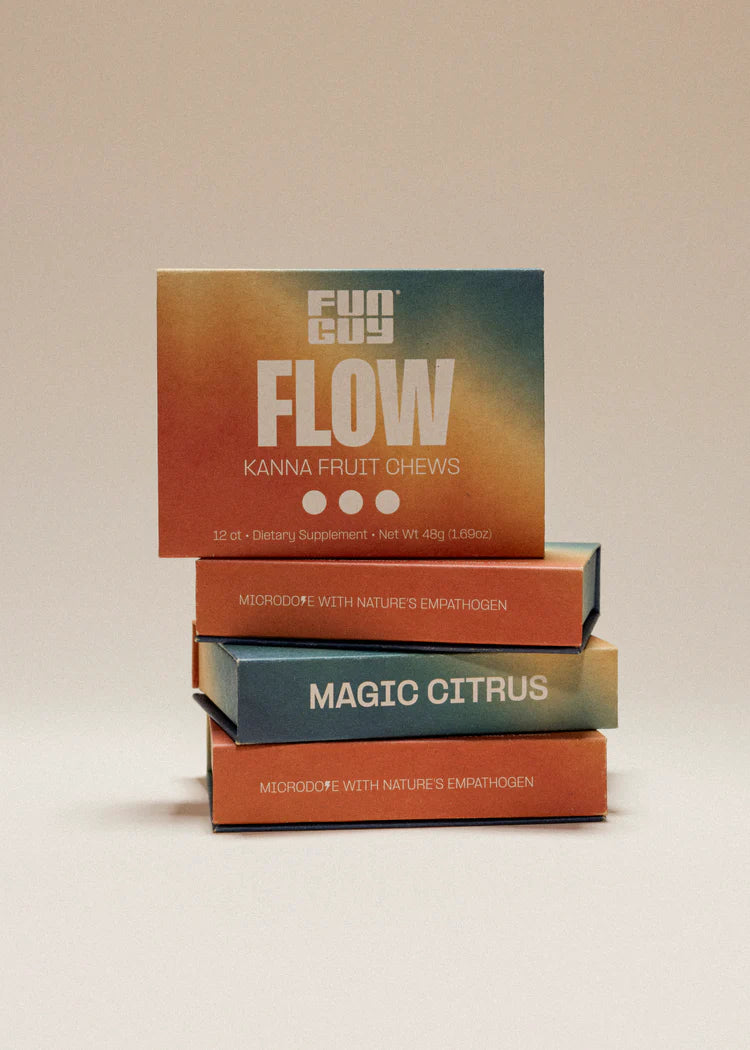
Fun Guy 'Flow' Chews
Fun Guy 'Flow' Chews are a fruit chew from Fun Guy built around kanna, with damiana, cordyceps and guarana. Each chew contains 50mg of high-potency kanna (5% alkaloids), and users report a shift in mood in as little as 30 minutes. It is the daytime, uplifted member of the line, sold as a single pack.
At a glance
- Fruit chew built around kanna, with damiana, cordyceps and guarana
- Each chew contains 50mg of high-potency kanna (5% alkaloids)
- Users report a shift in mood in as little as 30 minutes
- Contains caffeine from guarana, a daytime chew
- Base of agave, cane sugar and pectin with blood orange flavor
The herb. The star is kanna (Sceletium tortuosum), a South African succulent chewed and fermented by the San and Khoikhoi for generations. Damiana (Turnera diffusa) is a Mexican shrub brewed to lift mood, cordyceps is the energy mushroom of Chinese herbalism, and guarana (Paullinia cupana) is an Amazonian vine whose seeds carry caffeine.
What's in it. 50mg of kanna at 5% alkaloids per chew, its mesembrine-type alkaloids giving the bright, social lift. Damiana adds warmth, cordyceps its traditional link with endurance, and guarana's caffeine sharpens it into something energizing.
How to use. Start with one chew and wait. Kanna in this format comes on in about 30 minutes, so give it a full hour before judging. The maker's guidance is to start with one and work up, a second chew only after you have felt the first. Guarana adds caffeine, so count these toward your daily total and avoid late-day use.
What to expect. Users describe an elevated, open, social mood with physical energy underneath, suited to a hike, party or creative session. It is not a wind-down product; for the mellow side of the line see Fun Guy 'Chill' Chocolate.
Safety. Kanna at higher amounts can bring mild nausea, headache, jitteriness or a dip in appetite, and guarana's caffeine can add restlessness. These are dose-related; take fewer chews next time.
- Because of the kanna, do not combine with SSRIs, SNRIs, MAOIs or other serotonergic medications, including triptans, tramadol and St. John's Wort
- Do not mix with alcohol or other stimulants
- Not for use if pregnant, nursing or with a heart condition; for adults 21+ only
Ingredients and storage. Kanna, damiana, cordyceps, guarana. Other ingredients: agave nectar, cane sugar, pectin, citric acid, malic acid, carrot and grape extract (color), MCT oil, blood orange extract, arrowroot starch. Store sealed in a cool, dry place, heat softens the chews.
Common questions
- How much kanna is in each Fun Guy Flow Chew? Each chew contains 50mg of kanna at 5% alkaloids.
- How long do Fun Guy Flow Chews take to work? Users report feeling a shift in as little as 30 minutes.
Disclaimer. These statements have not been evaluated by the Food and Drug Administration. This product is not intended to diagnose, treat, cure, or prevent any disease. Kanna is a traditional botanical, and traditional use does not establish that it will produce any particular result. Consult your healthcare provider before use if you take any medication or have a medical condition. Use at your own risk and keep out of reach of children. Selected and sold by Healing Herbals, run by a practicing herbalist of 13+ years.
Choose options