Wild Dagga Is Not Cannabis, and Its Most Famous Compound May Not Even Be In It
TL;DR: Wild dagga (Leonotis leonurus) is in the mint family, not related to cannabis; "dagga" is simply the Afrikaans word for cannabis. Leonurine, often named as its active compound, has never been reported in scientific analyses of the plant. Its main compound is marrubiin, and it contains no THC or CBD.
The compound most often named as the active ingredient in wild dagga has probably never been found in the plant. Leonurine shows up in product descriptions, forum posts, and even encyclopedia entries as the thing that makes Leonotis leonurus work. A 2012 HPLC study by Kuchta, Ortwein and Rauwald, published in Die Pharmazie, looked for it directly. They found leonurine in Leonurus japonicus. They did not find it in Leonurus cardiaca. And they did not find it in Leonotis leonurus.
A 2015 review in the Journal of Ethnopharmacology by Nsuala, Enslin and Viljoen put it even more bluntly. Leonurine has never been reported by any scientific analysis of L. leonurus extracts. The claim appears to have entered popular writing through non-peer-reviewed sources and then copied itself outward for decades, helped along by the fact that Leonotis and Leonurus look almost identical in print.
So a widely repeated botanical fact is running on nothing. That matters here, because the other widely repeated fact about this plant is that its name means cannabis.
Where the name comes from
"Dagga" is Afrikaans, traced back to the Khoikhoi word dachab, and in South Africa it means cannabis. Full stop. Wild dagga is therefore "wild cannabis," and klip dagga is "stone cannabis." The names describe how the plants were used, smoked, and traded, not what they are related to.
Leonotis leonurus is a member of Lamiaceae, the mint family. Its relatives are rosemary, sage, basil, and horehound. Cannabis sits in Cannabaceae alongside hops. These are not close. The plants ended up sharing a name because people smoked both, not because they share chemistry.
What the plant actually contains
The 2015 review counted over fifty isolated compounds. The dominant class is labdane-type diterpenoids. Marrubiin is the major one, and it is the same labdane diterpene lactone that gives white horehound (Marrubium vulgare) its identity as a cough-drop herb. Also documented: premarrubiin, and the labdanes named leonotin, leonotinin, and dubiin, along with flavonoids such as apigenin derivatives.
No THC. No CBD. No cannabinoid of the classical phytocannabinoid type has been isolated from this plant.
There is one interesting wrinkle worth stating honestly. A 2020 paper in BMC Research Notes by Hunter and colleagues used LC-MS/MS on the flowers and tentatively flagged a fatty acid ethanolamide, 7,10,13,16-docosatetraenoylethanolamine, sometimes called adrenoyl-EA. That is a lipid signaling molecule, structurally more like your own endocannabinoids than like anything in a cannabis plant. The authors were careful about it. They had no authentic reference standard, the identification rested on database matching, and they wrote that further work would be required to confirm the exact identity. Anyone citing this as proof that wild dagga "contains cannabinoids" is overreading a cautious paper.
Could a labdane diterpene trip a THC screen?
Standard urine cannabinoid immunoassays are not looking for THC. They are looking for THC-COOH, the carboxylic acid metabolite your liver produces. The antibodies in those kits were raised against that specific molecule, and they respond to things shaped like it: a dibenzopyran core with a pentyl side chain and a specific hydroxyl and carboxyl arrangement.
Marrubiin is a bicyclic labdane with a lactone ring and a furan. It does not have the aromatic ring system the antibody recognizes. On structural grounds there is no reason to expect it to bind. A diterpene lactone and a cannabinoid metabolite look different enough that an antibody selective for one has no business grabbing the other.
Here is the honest part. No published study has taken wild dagga extract and run it through a panel of commercial THC immunoassays to check. The structural argument is strong. The direct experiment does not appear in the literature. Treat that gap as a gap, not as a guarantee.
For context, the interferences that are actually documented for cannabinoid screens are things like efavirenz (an HIV medication whose glucuronide metabolite produced false positives in most participants in one study), dronabinol (which is literally synthetic THC, so it is a true positive being read as a false one), and in-vitro contamination from certain soaps added to urine. Herbal material is not on that list.
The risk that is real, and it is not chemistry
If someone fails a THC screen after smoking wild dagga, the likeliest explanation is physical contamination.
- Shared equipment. A pipe, bong, grinder, or rolling tray that has handled cannabis carries resin. Wild dagga packed into that pipe picks up THC-containing residue. You are smoking two things.
- Shared sessions. Passing a joint of wild dagga around a circle where cannabis is also circulating is an obvious route. Johns Hopkins work on secondhand smoke found positives at the standard 50 ng/mL cutoff were rare and needed extreme, sealed-room exposure, so ambient smoke alone is unlikely. Actually inhaling from a contaminated device is a different situation.
- Adulterated product. This is the serious one. The 2015 review specifically documents deliberate adulteration of Leonotis material with synthetic cannabinoids for illegal sale. Synthetic cannabinoids generally do not trigger standard THC immunoassays, but they do show up on dedicated synthetic cannabinoid panels, and they carry real toxicity risk of their own.
Sourcing is the variable you can control. Plain, single-species botanical material from a seller who says what it is beats a nameless "herbal smoking blend" every time.
Klip dagga is a different plant
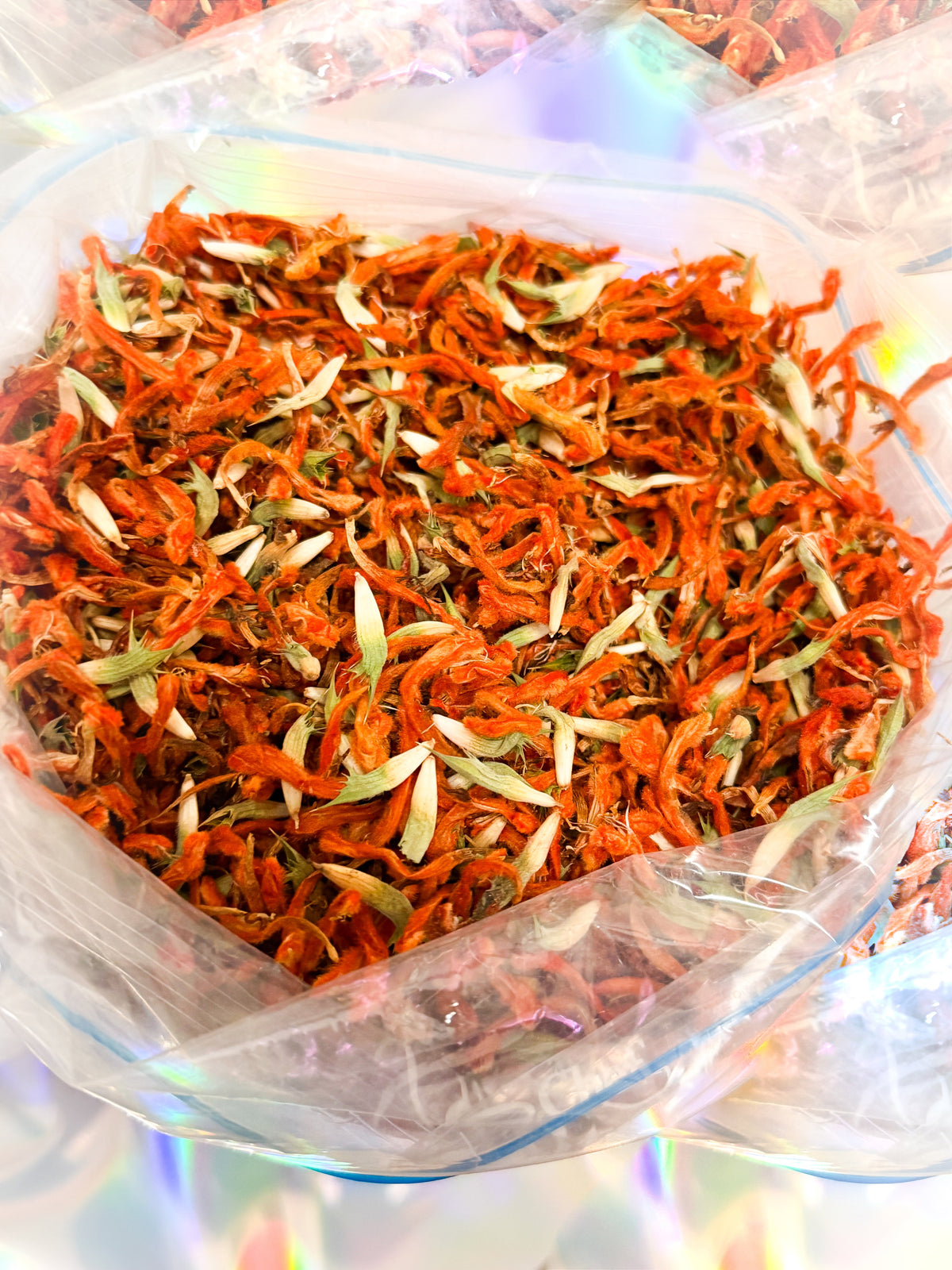
Leonotis nepetifolia, klip dagga, gets sold and shipped interchangeably with wild dagga constantly. They are separate species. Wild dagga has narrow, willowy leaves and bright orange tubular flowers in tidy tiered whorls. Klip dagga is coarser, with broad heart-shaped leaves and dense spiny globe-shaped flower heads that look like spiked balls on the stem. Klip dagga has been studied considerably less, and its diterpenoid profile is not the same.
Neither contains THC. But if you are buying for a specific reason, knowing which one is in the bag is basic. Dried and crushed, they are much harder to tell apart than they are in the garden, which is exactly why mislabeling persists.
Toxicity and legality, briefly
A 2008 rat study by Maphosa and colleagues tested aqueous extract of wild dagga shoots across acute, sub-acute, and chronic protocols. At high doses they recorded changes in red blood cell counts and hemoglobin, altered liver and kidney markers, organ histopathology, and deaths at 3200 mg/kg. The authors advised caution. These were concentrated water extracts given at heavy doses to rodents, not a description of traditional use, but it argues against treating the plant as automatically harmless because it is a plant.
Legally, the plant is unregulated in most of the world, including the United States. Poland and Latvia both restricted it in 2009, and Latvia placed it under Schedule 1. If you are shipping internationally, check your destination.
At Healing Herbals we keep our wild dagga and klip dagga listed as separate, named species, because the difference is real and the labeling problem in this corner of the market is genuinely bad.
This article is for informational and educational purposes only. It is not medical advice and does not describe treatment for any condition. Nothing here should be taken as guidance on passing, failing, or preparing for a drug test. If you are subject to workplace or legal testing, talk to the testing authority or a qualified professional about anything you consume.
Keep reading: Wild Dagga: Traditional Use, Compounds and Forms and Wild Dagga: A Natural Substitute for Tobacco and Cannabis.
%20is%20in%20the%20mint%20family,%20not%20related%20to%20cannabis;%20%22dagga%22%20is%20simply%20the%20Afrikaans%20word%20for%20cannabis.%20Leonurine,%20often%20named%20as%20its%20active%20compound,%20has%20never%20bee...)
Leave a comment
This site is protected by hCaptcha and the hCaptcha Privacy Policy and Terms of Service apply.