Honeysuckle Flowers
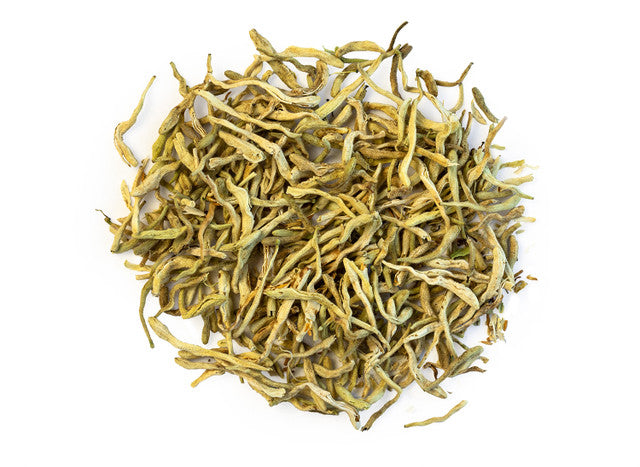
Honeysuckle Flowers are whole dried blossoms of Lonicera japonica, slow-dried at the peak of bloom so the buds keep their natural aroma and subtle floral sweetness. They arrive as slender cream-and-gold flowers that smell faintly of honey, sold loose for tea, syrups, tinctures and topical preparations. Offered in 4oz, 1LB and 10lb sizes.
At a glance
- Whole dried Lonicera japonica blossoms, slow-dried at peak bloom
- Caffeine-free
- Flavonoids such as luteolin, saponins, chlorogenic acid, iridoid glycosides such as loganin, plus a light volatile oil
- Steep 1 to 2 teaspoons in 8 oz for 5 to 10 minutes
- Offered in 4oz, 1LB and 10lb sizes
The herb. Japanese honeysuckle is a twining vine in the Caprifoliaceae family native to East Asia, where its paired white flowers turn gold as they age, which is why Chinese herbalists call it jin yin hua, the gold and silver flower. The flowers carry flavonoids such as luteolin, saponins, chlorogenic acid and iridoid glycosides such as loganin, plus a light volatile oil.
What's in it. Dried honeysuckle flowers only, with no caffeine content. The volatile oil gives the honeyed scent, the flavonoids and chlorogenic acid give the clean, slightly bitter-cooling finish, and the saponins add a faint softness on the tongue.
Dosage and use. Place 1 to 2 teaspoons of dried flowers in a cup, add 8 oz of hot water, steep 5 to 10 minutes and strain. Start with 1 teaspoon, since a long steep drifts toward bitterness. Take it plain or with honey, mint or chamomile. It is light enough for a daily cup, iced in summer or blended with chrysanthemum or green tea. For a syrup, simmer a strong infusion down with honey or sugar; the flowers also infuse into oil or witch hazel for topical use.
What to expect. A delicate, cooling, floral cup users describe as refreshing and calming without any heaviness. It is a sensory tea rather than a strong one, and it will not make you drowsy. It sits naturally alongside our Whole Rose Buds in a floral blend.
Side effects. The flowers are relatively safe for most adults. A very strong cup can feel cooling on the stomach or mildly upset digestion in sensitive people; lighten the steep and it passes. Only the flowers are used; honeysuckle berries are not edible.
Interactions and cautions. No significant interactions are widely documented for honeysuckle flower tea. If you are pregnant, nursing or on medication, consult a healthcare professional prior to repeated use, and patch-test any topical preparation first.
Ingredients and storage. Dried Honeysuckle Flowers (Lonicera japonica). Keep sealed in a cool, dark, dry cupboard; the flowers lose their scent quickly if exposed to light and air.
Common questions
- How do you make honeysuckle flower tea? Steep 1 to 2 teaspoons in 8 oz of hot water for 5 to 10 minutes and strain, plain or with honey.
- Do honeysuckle flowers have caffeine? No, the cup is entirely caffeine-free.
Disclaimer. These statements have not been evaluated by the Food and Drug Administration. This product is not intended to diagnose, treat, cure, or prevent any disease. Honeysuckle is a traditional botanical, and traditional use does not establish that it will produce any particular result. Consult your healthcare provider before use if you take any medication or have a medical condition. Use at your own risk and keep out of reach of children. Formulated by Healing Herbals, run by a practicing herbalist of 13+ years.
Choose options