Jamaican Dogwood Contains a Fish Poison. Here Is Why No Drug Test Looks for It.
TL;DR: Jamaican dogwood bark contains rotenone, the compound that earned the plant its fish-poison names, but no standard 5, 10 or 12 panel drug test screens for it or anything else in the bark, and there's no documented cross-reactivity. Rotenone methods exist in agricultural and environmental labs, not hospital tox labs. The real concern is an interaction question, not a testing one: it can add to the effect of sedatives, so tell your provider what you take.
The bark you can buy as a sleep herb is the same bark Taino fishermen crushed and threw into tidal pools to stun fish so they could be picked up by hand. That is not folklore embroidery. It is where the plant gets its Latin name. Piscidia means fish-killer, and piscipula means fish-trap. The English common names are worse: fishpoison tree, fishfuddle.
The compound responsible is rotenone. If that name rings a faint bell, it is because rotenone spent decades as a botanical insecticide, and it is now better known to neuroscientists than to gardeners. So the obvious question follows. Does any of this show up on a drug test, or throw off bloodwork at a doctor's office? The short answer is no. The long answer is more interesting than the short one.
What the Bark Contains
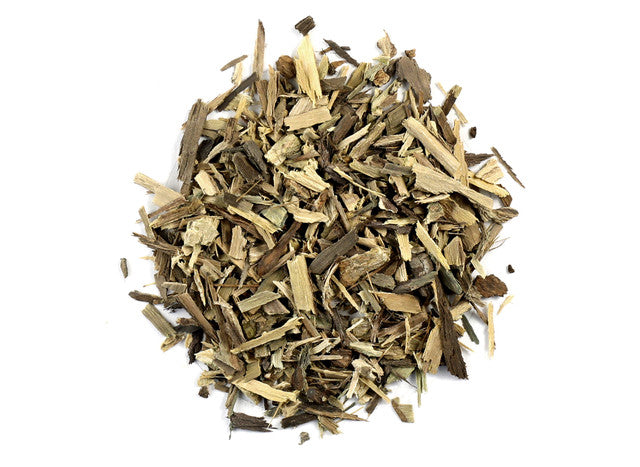
Jamaican dogwood root bark is chemically busy. The two main families are rotenoids and isoflavones.
- Rotenoids: rotenone, millettone, isomillettone, dehydromillettone
- Isoflavones: ichthynone, jamaicin, piscidone, piscerythrone, lisetin
- Other: piscidic acid, beta-sitosterol, tannins, resins, a trace volatile oil
Piscidic acid was already being isolated and characterized by the early twentieth century. The 1918 US Dispensatory describes crystalline constituents pulled from the bark with specific melting points, which tells you chemists were taking this plant seriously a hundred years ago. What they never established was a clean dose-response picture in humans. That gap has not really closed.
The Rotenone Problem
Rotenone blocks complex I of the mitochondrial electron transport chain. Cells stop making ATP efficiently. Fish are exquisitely vulnerable because rotenone is fat-soluble and passes straight through lipid-rich gill tissue into the bloodstream. Mammals are far less vulnerable for a boring reason: rotenone is poorly absorbed from the gastrointestinal tract and gets metabolized quickly. Route of exposure does most of the work here.
That same complex I inhibition made rotenone a workhorse of Parkinson's research. Researchers give rotenone to rats and reliably produce dopaminergic neuron loss, alpha-synuclein aggregation, and parkinsonian motor deficits. It is one of the standard animal models in the field. On the human side, a 2011 case-control analysis from the Farming and Movement Evaluation Study reported an association between occupational rotenone use and Parkinson's disease among agricultural applicators.
Context matters enormously. Those studies involve isolated rotenone at concentrations and exposure routes nothing like a bark tincture, and applicator exposure is repeated and occupational. Whole bark is a dilute, mixed matrix. But anyone selling or using this plant should know the pharmacology rather than learn it from a headline. Herbal practitioner associations in the UK apply voluntary dose restrictions to Piscidia, which is a quiet signal about how the professional herbal world reads the same data.
Drug Panels: The Clear Answer
No standard drug panel screens for rotenone, rotenoids, isoflavones, or any Piscidia constituent. Not the 5-panel, not the 10-panel, not the 12-panel.
Those panels are built around a fixed list. The federal 5-panel covers amphetamines, cannabinoids, cocaine metabolite, opiates, and PCP. Expanded panels add benzodiazepines, barbiturates, methadone, propoxyphene, methaqualone, and similar. Each target has an antibody-based immunoassay tuned to a specific molecular shape and a defined cutoff concentration.
Rotenone is an isoflavonoid-derived molecule with nothing structurally in common with an amphetamine or an opiate. There is no commercial immunoassay reagent for it because there is no market for one. Nobody is diverting fish poison recreationally.
False positives happen when a molecule looks enough like a panel target to bind the antibody. That is why certain antihistamines, decongestants, and antidepressants have documented cross-reactivity in the toxicology literature. Jamaican dogwood constituents do not appear in those documented interference lists.
Two Different Analytical Worlds
Almost nobody untangles this next bit. Rotenone is routinely detected in labs. Just not those labs.
Agricultural and environmental chemistry has well-developed rotenone methods. Multi-residue pesticide screens by LC-MS/MS and GC-MS cover hundreds of compounds including rotenone. Fisheries programs monitor rotenone and its degradation products in treated waters after invasive fish eradication projects. Those methods exist, they are validated, and they work.
Clinical toxicology is a different building entirely. A published fatal rotenone ingestion case in a critical care journal noted plainly that the treating team could not find a suitable method to quantify rotenone concentrations in the patient. The diagnosis rested on history and on aspirated gastric contents, not on a serum level. Food chemists can measure rotenone in a tomato. A hospital tox lab generally cannot measure it in your blood on a Tuesday night.
So if you ever needed Piscidia exposure documented analytically, you would need a specialty reference lab willing to run a targeted LC-MS/MS method with proper reference standards. That is a research request, not a checkbox on a requisition form.
The Medical Record, Such As It Is
Jamaican dogwood entered Western medicine in the late 1800s through Eclectic physicians, who used it for neuralgia, migraine, nervous insomnia, dysmenorrhea, and whooping cough, often framed as an opium alternative. King's American Dispensatory of 1898 and the 1918 US Dispensatory both carry entries, typically for a fluid extract.
What is striking is how candid those old texts are. One practitioner reported it caused severe nausea and gastric distress with no sedative effect whatsoever. Another documented convulsions following a half-drachm dose. The 1918 Dispensatory states outright that the exact practical value of the drug had not been determined. Modern sources add that excessive amounts may cause numbness, tremor, sweating, and salivation.
Human clinical trial evidence remains essentially absent. Animal work suggests sedative and antispasmodic activity. That is where the literature stops, and pretending otherwise would be dishonest.
Practical Takeaways
- No employment or clinical drug panel screens for Jamaican dogwood constituents.
- There is no documented cross-reactivity with common immunoassay targets.
- Rotenone assays live in agricultural and environmental chemistry, not tox screening.
- Tell your provider what you take anyway. Piscidia has documented additive effects with sedatives and CNS depressants, and that is a real interaction question, separate from testing.
- It is commonly cautioned against in pregnancy, breastfeeding, bradycardia, and low blood pressure.
We carry both Jamaican Dogwood Bark and Jamaican Dogwood Extract at Healing Herbals, and we would rather you arrive at them knowing the rotenone story than discover it later and feel misled. Botanicals with real pharmacology deserve real information, including the awkward parts.
This article is for informational and educational purposes only. It is not medical advice, and nothing here is intended to diagnose, treat, cure, or prevent any disease. Talk with a qualified healthcare provider before using any botanical product, especially if you are pregnant, nursing, taking medication, or managing a health condition.
Keep reading: Kava and Lab Work: The False Positive Nobody Warns You About and Corydalis, L-THP and the Alkaloid Nobody Tests For.

Leave a comment
This site is protected by hCaptcha and the hCaptcha Privacy Policy and Terms of Service apply.