
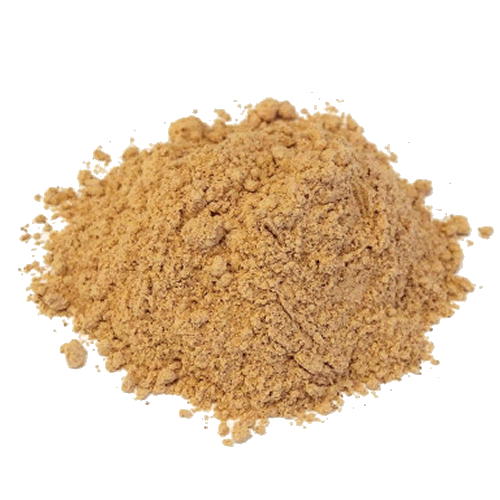
Akuamma Is Not Built Like an Opiate: The Drug Test Question Nobody Has Actually Studied
TL;DR: Akuammine, akuamma's main alkaloid, binds mu-opioid receptors about a thousand times more weakly than morphine and isn't built like an opiate. Nobody has actually tested whether it triggers opiate screens.
The most abundant alkaloid in an akuamma seed, akuammine, makes up roughly 0.56% of the dried seed powder. It binds the mu-opioid receptor. And in the 1998 study that first measured this properly, it did so with an affinity of about 0.5 micromolar, which is somewhere in the neighborhood of a thousand times weaker than morphine at the same target. Weaker still, that binding produced antagonist behavior in tissue assays rather than the agonist response you would expect from something opiate-like.
That single fact sets up everything interesting about akuamma and drug testing. The seed talks to opioid receptors. It does not look anything like an opiate.
The Alkaloid Roster Is Bigger Than People Think
Picralima nitida seeds run about 3.5% to 4.8% total alkaloids by weight, which is a remarkably loaded seed. The cast includes akuammine, akuammidine, akuammicine, akuammigine, pseudo-akuammigine, picraline, picralinal, and akuammiline itself.
They do not all behave the same way. From the 1998 European Journal of Pharmacology work by Menzies and colleagues:
- Akuammidine bound mu at 0.6 μM, delta at 2.4 μM, kappa at 8.6 μM
- Akuammine bound mu at 0.5 μM, its strongest single affinity
- Akuammicine went the other direction entirely, hitting kappa at 0.2 μM as a full kappa agonist in guinea pig ileum
- Akuammigine and pseudo-akuammigine barely registered any functional effect at all
The authors' own conclusion was blunt. None of these compounds showed high affinity or real selectivity for any opioid receptor subtype. A 2020 paper in the Journal of Natural Products revisited the question with modern methods, screened five of the alkaloids against a panel of more than forty CNS receptors, and confirmed opioid receptors were the primary target. Three showed micromolar mu activity. One was a potent kappa agonist. The mu compounds showed limited efficacy in thermal pain assays despite the plant's traditional reputation.
The Structural Point That Decides the Drug Test Question
This next part rarely gets explained properly.
Akuamma's alkaloids are indole alkaloids. Same broad structural family as yohimbine and mitragynine. They are built on a tryptamine-derived indole core wrapped into elaborate polycyclic cages.
Morphine and codeine are morphinans. A completely different scaffold, derived biosynthetically from tyrosine rather than tryptophan, with a phenanthrene skeleton and a characteristic bridged ring system.
Now consider how an opiate immunoassay actually works. It is an antibody raised against morphine, calibrated to morphine, and it detects other drugs only to the extent that they physically resemble morphine's shape. This is why the assay catches codeine and hydromorphone well, catches oxycodone poorly enough that it takes roughly six times the concentration to trigger a result, and misses fentanyl, methadone, and buprenorphine almost entirely. Those last three have opioid activity in abundance. They just do not have the morphinan shape, so the antibody has nothing to grab.
Receptor affinity and antibody affinity are two separate recognition events. A compound can activate an opioid receptor and still be invisible to a morphine antibody. On structural grounds, akuamma's alkaloids sit in that category.
The Akuammiline Cage
The akuammiline alkaloids are named after this plant, and chemists know them well for a reason unrelated to pharmacology. Every member of the class carries a quaternary carbon at C7, a fully substituted carbon center that sits at the heart of a cage-like architecture. Even the simplest akuammilines contain at least five fused rings and a stack of stereocenters. Several have methanoquinolizidine cores that resisted total synthesis for decades.
That cage geometry is the opposite of the relatively flat, compact morphinan framework an opiate antibody is shaped around.
The Limit of the Argument
All of that is a structural argument, not a measurement. And the measurement does not exist.
There is no published cross-reactivity data for akuamma alkaloids on opiate immunoassay panels. Not studies showing they pass clean. Not studies showing they trigger. Nothing. No one has run akuammine through a CEDIA or EMIT opiate screen and published the result.
That distinction matters practically. A negative finding would let you say "tested and clear." An absent finding means the structural reasoning is the only thing available, and structural reasoning has been wrong before.
The Kratom Precedent Nobody Brings Up
Mitragynine is an indole alkaloid with opioid receptor activity, from a completely different plant family than the poppy. By the structural logic above it should be immunologically invisible.
It is not. Researchers documented that a glucuronidated kratom metabolite produced false positive results on the Thermo Scientific CEDIA Methadone Metabolite (EDDP) immunoassay. Enzymatic hydrolysis of the urine increased the signal, confirming the metabolite as the culprit. Mass spectrometry reflex testing sorted the real methadone cases from the kratom cases.
Two things stand out. The interference was with a methadone assay, not an opiate one, which nobody would have predicted from structure. And the compound responsible was a metabolite, not the parent alkaloid. Nobody screens the metabolites of an untested botanical in advance.
That is the strongest available reason to stay humble about akuamma. The closest structural analog with a comparable pharmacological profile turned out to have immunoassay behavior that no one anticipated on paper.
Could a Lab Detect Akuamma If It Wanted To
Technically yes. Practically no.
Detecting akuammine requires LC-MS/MS with an authentic akuammine reference standard to match retention time and fragmentation. Research groups have done it, quantifying akuammine down to 1 ng/mL by UPLC-MS/MS in pharmacokinetic work. But a reference standard for an obscure West African indole alkaloid is not sitting in a routine toxicology lab's method library, and akuamma appears on no standard panel. A lab has to be looking for it specifically, with the right standard on hand.
Worth noting from that same pharmacokinetic work: akuammine showed only about 12% oral bioavailability, with plasma Cmax around 10.6 ng/mL, and the other alkaloids fell below detection entirely. Most of these compounds have half-lives under five minutes in liver microsomes. There is not much circulating to find.
What an Extract Ratio Tells You, and What It Does Not
Alkaloid content varies between seed lots by origin, harvest timing, maturity, and storage. A "20:1" claim describes a manufacturing input ratio, twenty units of raw material reduced to one. It says nothing about the akuammine concentration in the finished product, because the starting material was never standardized to begin with. Two 20:1 extracts from different seed batches can differ substantially.
Akuamma remains unscheduled in the United States and has a long documented history in West Africa, from Côte d'Ivoire through to Uganda, where seeds were chewed or powdered and used as a quinine substitute for fever, among other traditional applications.
If you are sourcing akuamma in any form, whole seed, extract powder, resin, or akuammine isolate, ask the vendor what they actually know about the batch rather than what the ratio on the label implies. Healing Herbals stocks the full range and is happy to talk sourcing specifics.
This article is for informational and educational purposes only. It is not medical advice, and nothing here is intended to diagnose, treat, cure, or prevent any condition. Akuamma products are not evaluated by the FDA. If you are subject to drug testing, disclose all supplements to the testing authority or your medical review officer.
Keep reading: Kratom and Drug Tests: The False Positive Runs Both Ways and Cat's Claw Shares a Family Tree With Kratom.

Leave a comment
This site is protected by hCaptcha and the hCaptcha Privacy Policy and Terms of Service apply.