Cat's Claw Shares a Family Tree With Kratom. That Raises a Question.
TL;DR: Cat's claw and kratom are both in the Rubiaceae family and share related alkaloid structures, like mitraphylline and mitragynine. No study has tested whether cat's claw alkaloids trigger a dedicated mitragynine drug screen, so nobody can say for sure. Cat's claw doesn't show up on standard 5, 10 or 12 panel tests, and LC-MS/MS confirmation can tell the compounds apart.
One of the main alkaloids in cat's claw is called mitraphylline. The main alkaloid in kratom is called mitragynine. Those names are not a coincidence. Both plants belong to the Rubiaceae family, and the chemists who named these compounds were looking at closely related molecular skeletons.
That shared chemistry is the starting point for a question almost nobody asks, and one the published literature has not answered.
The family tree matters more than you would expect
Uncaria tomentosa is one species in a genus that also includes Uncaria rhynchophylla, the Chinese herb gou teng. Cat's claw and gou teng share alkaloids outright. Rhynchophylline and isorhynchophylline, named for the Chinese species, both turn up in South American cat's claw bark.
Move one step further out and you reach Mitragyna speciosa, kratom. Different genus, same family, and a real overlap in alkaloid architecture. Cat's claw carries indole and oxindole alkaloids including mitraphylline, isomitraphylline, pteropodine, isopteropodine, uncarine, speciophylline, rhynchophylline and isorhynchophylline. Kratom carries mitragynine, speciogynine, speciociliatine and paynantheine. These are cousins built on a shared corynanthe-type core.
Why that could theoretically matter
Immunoassays do not identify molecules. They use antibodies that bind to a shape. If a different compound presents a close enough shape, the antibody grabs it and the machine reports a positive that never happened.
Kratom has already demonstrated this in both directions. Research presented in the American Journal of Clinical Pathology reported a kratom metabolite triggering false positive urine screens for methadone. More recently, work on the CEDIA mitragynine immunoassay found the reverse problem: methadone and its metabolite EDDP cross-reacted with the mitragynine antibody. In that dataset, 395 specimens screened positive and LC-MS/MS confirmation showed 49 of them, about 12.4 percent, were false. Among the false positives with methadone data available, over 80 percent had methadone and EDDP present.
The same assay also picks up other kratom alkaloids by design, including speciociliatine, speciogynine and paynantheine. So the antibody is known to be somewhat loose. It recognizes a structural neighborhood, not a single compound.
What nobody has tested
No published study has tested cat's claw alkaloids against a mitragynine immunoassay. Not mitraphylline, not pteropodine, not rhynchophylline. Searching the toxicology and clinical chemistry literature turns up cross-reactivity panels for methadone, EDDP and kratom's own alkaloids, and nothing at all for Uncaria tomentosa.
That absence is worth stating plainly instead of filling with speculation. The structural relationship is real. The question is reasonable. The data does not exist. Anyone who tells you cat's claw definitely will or definitely will not register on a dedicated mitragynine panel is guessing.
Two things temper the concern. Confirmation testing is done by LC-MS/MS, which separates compounds by retention time and fragmentation pattern rather than shape, and mitraphylline and mitragynine are clearly distinguishable by those criteria. And dedicated kratom panels are not routine. They are ordered specifically, mostly in pain management and treatment monitoring settings.
Standard panels are a different story
On a 5, 10 or 12 panel urine screen, cat's claw does not appear. Those panels target amphetamines, cocaine metabolites, THC, opiates, PCP, benzodiazepines, barbiturates, methadone, propoxyphene, methaqualone and a few additions depending on the provider. There is no oxindole alkaloid antibody anywhere in that lineup, and no reported cross-reactivity between cat's claw constituents and those targets.
The POA versus TOA argument is shakier than the marketing suggests
You will see cat's claw products advertised as "TOA free." The claim behind it is that tetracyclic oxindole alkaloids antagonize the pentacyclic ones and blunt the herb's activity.
The evidence base for that is thin. The antagonism claim traces to a small number of in vitro investigations connected to the company marketing the TOA-free product, and it has not been independently reproduced in animals or humans. Earlier work from the original Austrian research group had actually described isorhynchophylline, a tetracyclic alkaloid, as stimulating phagocytosis. The premise is contested and largely commercial.
What is genuinely true is that alkaloid ratios vary. Seasonality, plant part and growing region all shift the profile, which means two authentic cat's claw products can differ chemically without either being fake.
Species substitution is the bigger quality problem
Uncaria guianensis is a separate species, easier to harvest, and sold in the same supply chains. It naturally carries a different alkaloid balance. Some of what gets described as an unusual "chemotype" of tomentosa may simply be misidentified guianensis.
Analytical chemists have built methods to tell them apart, using LC with photodiode array detection alongside FT-IR and UV spectra fed into multivariate models, specifically framed as adulteration detection tools. Large scale DNA barcoding surveys of retail cat's claw appear not to have been published, though barcoding has been applied broadly across the medicinal plant trade with uncomfortable results. Species identity on the label is worth more than an alkaloid percentage you cannot verify.
The interaction that actually has a case report
This is the part people should pay attention to. Cat's claw inhibits CYP3A4, the enzyme responsible for metabolizing a very large share of prescription drugs.
A 2008 report in the European Journal of Clinical Pharmacology described a patient on the protease inhibitors atazanavir, ritonavir and saquinavir who added cat's claw. Atazanavir levels rose to roughly four times the expected concentration, with similar rises in the other two. No overdose symptoms occurred, and levels returned to normal within about 15 days of stopping the herb. Liverpool's HIV drug interaction database rates the evidence as very low quality, being a single case, and still advises avoiding the combination.
In vitro work has also flagged induction of UGT1A3, UGT1A9 and CYP2J2, and PXR activation by constituents of both Uncaria species, which points toward effects in both directions. Clinical relevance beyond that one case is not established. Anyone on anticoagulants, immunosuppressants, antiretrovirals or anything with therapeutic drug monitoring should talk to their prescriber before adding it.
Bloodwork and immune markers
Cat's claw is marketed as an immune herb, so it is fair to ask whether it moves lab values. Preclinical research has reported stimulation of myeloid progenitor cells and various immune cell populations. Human data is limited. A case of acute renal failure was reported in a patient with lupus, and worsening motor symptoms in a patient with Parkinson's disease. If you have autoimmune disease or are on immunosuppressive therapy, this is a conversation for your clinician, not a supplement aisle decision.
What to take from all this
Cat's claw is not a drug test problem on any standard panel. It sits in an interesting and genuinely unstudied position relative to specialized kratom panels, and honesty requires saying the research has not been done. The real practical issues are species authenticity and CYP3A4.
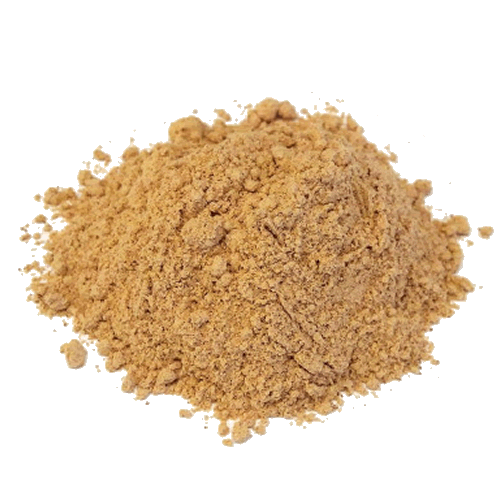
Those first two are solved by sourcing. We carry both Cat's Claw (Uncaria tomentosa) and Cat's Claw Extract Resin with clear species identification, because knowing exactly what plant is in the bag is the part you should never have to guess at.
This article is for informational and educational purposes only. It is not medical advice, and nothing here is intended to diagnose, treat, cure or prevent any disease. Consult a qualified healthcare provider before using any herbal product, particularly if you take prescription medication or have a medical condition.
Keep reading: Kratom and Drug Tests: The False Positive Runs Both Ways and Akuamma Is Not Built Like an Opiate.

Leave a comment
This site is protected by hCaptcha and the hCaptcha Privacy Policy and Terms of Service apply.