
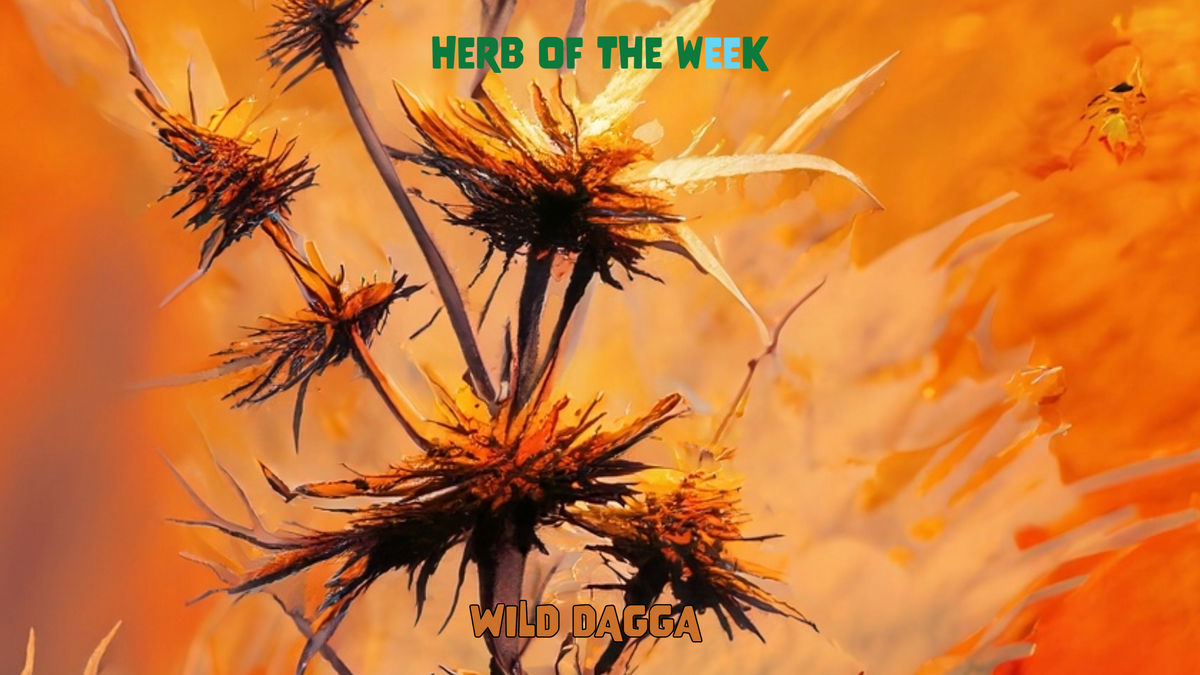
Wild Dagga: Serenity of South Africa's Lion's Tail
TL;DR: Wild dagga (Leonotis leonurus), also called lion's tail, is a South African plant with bright orange flowers that has a long traditional history, including being smoked by the Khoikhoi and San for ritual and relaxation. People today use it as a tea, tincture or smoke for a mild, calm feeling that's often compared to cannabis but is much gentler.
Wild dagga is one of the prettiest plants we carry. Those orange flowers stacked up the stem look like something out of a botanical garden, and a lot of people first meet it as a landscaping plant before they ever learn it has a history as a smoke and a tea.
What wild dagga is
Wild dagga, scientifically Leonotis leonurus, is native to South Africa. It's known for its bright orange, tubular flowers that grow in whorls around the stem. Because of the shape of those blooms it also goes by lion's tail or lion's ear. It's a tough, fast growing shrub, and hummingbirds and bees love it, so you'll see it planted in gardens in warm climates all over the world.
Traditional use in South Africa
Historically wild dagga held an important place in traditional South African herbalism. Indigenous communities used it for a wide range of things, from fevers and headaches to snakebites and scorpion stings.
What it's most famous for, though, is its mild psychoactive effect. It's often compared to cannabis, and "dagga" is actually a South African word for cannabis, but wild dagga is a completely different plant and much less potent. The Khoikhoi and San people (older texts call them Hottentots and Bushmen, names now considered offensive) smoked it as part of spiritual rituals and to relax.
The compounds behind it
The calming effect of wild dagga is usually credited to a compound called leonurine, said to be found in the leaves and flowers. Leonurine is often described as producing a calm, mildly euphoric feeling, and that's the reason wild dagga shows up in so many herbal smoking blends.
We'll be honest with you, the chemistry here isn't fully settled. Some analyses have questioned how much leonurine is actually in Leonotis leonurus, and the plant contains other compounds, like marrubiin, that researchers look at too. So we describe the effect based on what people report, and we don't oversell a single molecule.
How people use it today
These days wild dagga is mostly used for a calm, unwinding feeling at the end of a long day. It comes as dried leaf and flower for tea or smoking, and as tinctures. Tea is gentle and earthy, a bit bitter, and pairs well with a little honey or mint. Smoking gets you there faster and shorter, and people often mix it into herbal blends as a base. And of course, it's still grown just for looks, since those flowers are hard to beat.
At the shop, a common tip we give is to start with a small amount of the tea before trying a smoke blend. That way you know how you personally respond to it. For tea, a teaspoon or two of dried leaf and flower in hot water for about ten minutes is a good place to begin, and you can always make the next cup stronger.
Safety and good sense
Wild dagga is generally considered safe, but it still has an effect and should be used responsibly. Be aware of the mild psychoactive feeling and don't drive or run heavy machinery after using it. As with any herb, check with a healthcare provider before starting, especially if you take medication or have an existing health condition. Pregnant or nursing people should skip it.
Common questions
Is wild dagga related to cannabis?
No. It's in the mint family. The name comes from a South African word for cannabis, and the effects are often compared, but wild dagga is much milder.
How do people take it?
As a tea, a tincture or dried leaf and flower for smoking, often in blends.
Is it strong?
Most people describe it as mild and relaxing. Start small anyway.
Wild dagga is a gorgeous plant with a long traditional story and a gentle, calming reputation. Treat it with a bit of respect and it makes a nice addition to an evening wind down.

Written by Herbal Healings
,%20also%20called%20lion's%20tail,%20is%20a%20South%20African%20plant%20with%20bright%20orange%20flowers%20that%20has%20a%20long%20traditional%20history,%20including%20being%20smoked%20by%20the%20Khoikhoi%20and%20S...)
Leave a comment
This site is protected by hCaptcha and the hCaptcha Privacy Policy and Terms of Service apply.