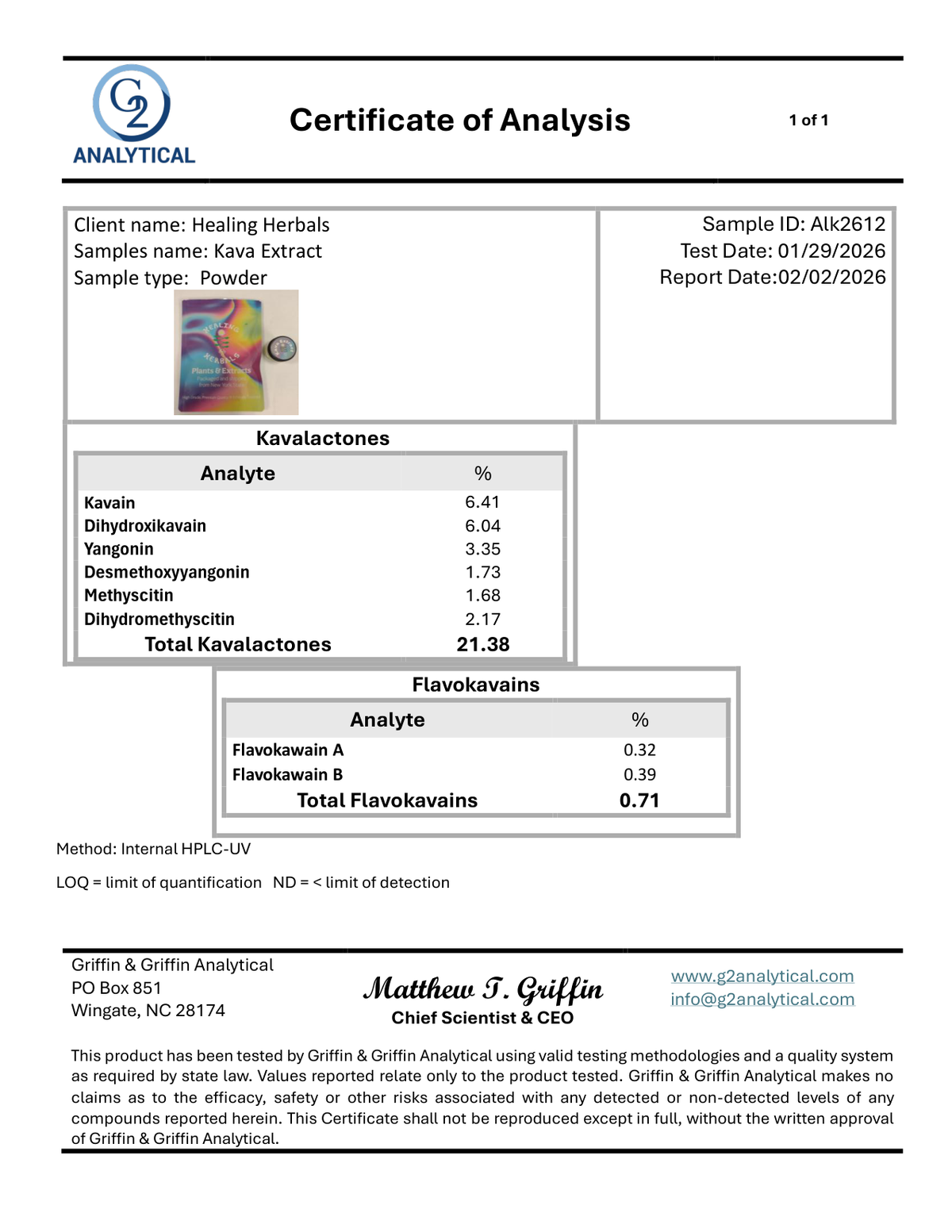
Lab Results: High Potency Kava Extract Powder, Alk2612 (21.38% Total Kavalactones)
This post in our Lab Results series moves from kanna to kava. One report per post, plain language, no numbers we cannot point at. This one is the G2 Analytical report on our High Potency Kava Extract Powder.

The report at a glance
- Product: High Potency Kava Extract Powder
- Lab: G2 Analytical
- Sample ID: Alk2612
- Tested: January 29, 2026
- Flavokavains: 0.71%
- Result: total kavalactones 21.38%
What was tested, and in what form
The sample was the finished extract powder, not raw root and not a prepared drink. That distinction matters on a kava report. Root powder, an extract powder and a resin are three different materials with three different concentration ranges, and a number from one tells you nothing about the others. This report describes the dry powder as it ships.
The card on our Lab Results page lists the lab, the sample ID and the test date. It does not list the analytical method, so we are not going to name one here. The two figures the card does carry, total kavalactones and flavokavains, are the two things a kava potency report exists to answer.
What total kavalactones means
Kavalactones are the group of compounds a lab quantifies in kava. There are six that get reported most often: kavain, dihydrokavain, methysticin, dihydromethysticin, yangonin and desmethoxyyangonin. A lab measures each one separately against a reference standard, then adds them up. That sum is the total kavalactones figure.
On this report the sum is 21.38%. A percent by weight means grams per 100 grams, so 21.38% is 21.38 grams of kavalactones per 100 grams of powder, or 213.8 mg per gram. Moving the decimal one place to the right is the whole conversion. That is the same arithmetic on every kava report, which is what lets you line up one batch against another instead of trusting an adjective on a label.
We are quoting the total here and not the six individual lines, because the total is what the card carries. The breakdown, if the lab printed one, is on the certificate image above.
What the flavokavain line is doing there
Flavokavains are a separate family of compounds found in kava, chemically distinct from the kavalactones. They are reported on their own line and they are not part of the total kavalactones sum. Adding 0.71% to 21.38% would be a mistake. Labs break them out because they are measured separately and because buyers increasingly ask for the figure. On this report flavokavains came back at 0.71%.
ND and below LOQ
You will see both on kava and kanna reports, and they do not mean the same thing. ND stands for not detected. The instrument saw nothing for that compound. Below LOQ means below the limit of quantitation: the instrument may have seen something, but not enough to put a reliable number on. Neither one is a zero in the mathematical sense. Both mean the lab declined to report a figure, and a careful report says which of the two applies. Neither term appears on the headline lines of this report.
Matching your bag to this report
Look at your label or packing slip for a sample, batch or lot number. If it reads Alk2612, this report is yours. A different number means a different run. Email us the number at herbalhealingsmarketing@gmail.com and we will send the matching certificate.
Kava is an agricultural product. Cultivar, growing region, the age of the root at harvest, how much lateral root went into the lot and how the extract was made all move the kavalactone number. A report is tied to a sample for that reason, not printed once on every bag and forgotten.
Verify it yourself
G2 Analytical does not publish a public share page for this report the way Phytodex does for our kanna work, so there is no verification link to give you. What you can do is compare the certificate image above against the sample ID, date and figures listed on the card, line for line. If you want the original file from us directly, ask and we will send it.
Product page: High Potency Kava Extract Powder. Every report we have posted lives on the Lab Results page. If this is your first time reading one of these, start with How to read a botanical lab report.
Healing Herbals (Holistic Plant Remedies LLC) grows and extracts its own kanna in South Africa and tests finished products with independent US labs. Our kava is sourced, not grown by us, and it goes to the same kind of independent lab. Every report we post lists a batch, lot or sample number so you can match it to what is in your hands.
Next in the series: the Cora Science report on our 85% kavalactone kava resin, lot 24-12-KAV-OL-03.
Lab results are provided for information only and apply to the tested sample. For adults 21 and over. These statements have not been evaluated by the Food and Drug Administration. This product is not intended to diagnose, treat, cure, or prevent any disease.

Written by Herbal Healings

Leave a comment
This site is protected by hCaptcha and the hCaptcha Privacy Policy and Terms of Service apply.