Article: Lab Results: Field Grown Kanna Leaf Pesticides, Report PHY-2026-868 (59 of 59 Not Detected)

Lab Results: Field Grown Kanna Leaf Pesticides, Report PHY-2026-868 (59 of 59 Not Detected)
The first five posts in this series were potency reports: how much alkaloid or kavalactone was in a sample. This one is a different kind of test. It asks whether a list of agricultural pesticides shows up in our field grown kanna leaf, and it answers for 59 of them at once. The lab completed it on October 12, 2026, which makes it the newest report on our page.

The report at a glance
- Product: Field Grown Kanna Leaf, listed in our shop as Milled / Powderized Kanna Leaf (Field Grown)
- Lab: Phytodex, an independent US lab
- Report number: PHY-2026-868
- Sample ID: 20261013-4456
- Completed: October 12, 2026
- Panel: Pesticides Panel, 59 compounds
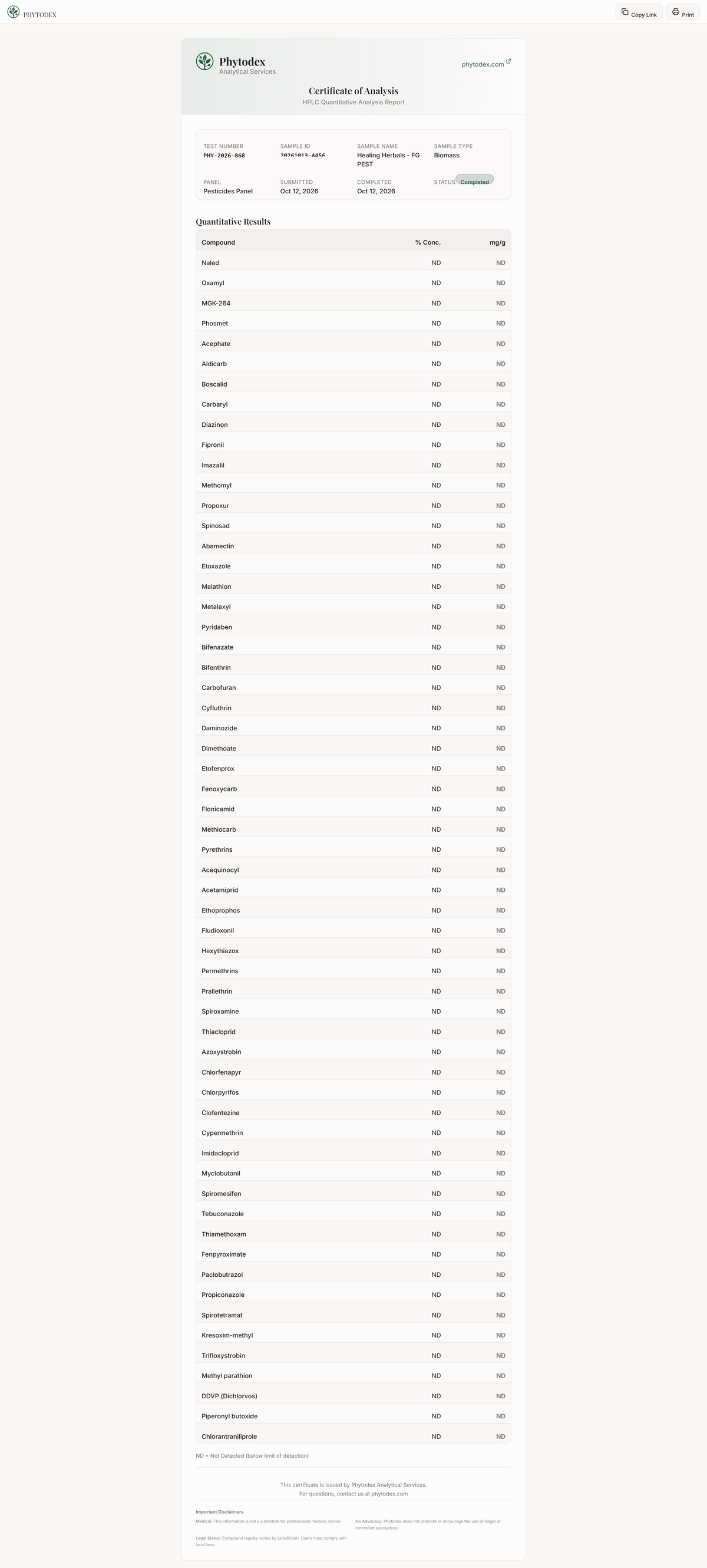
- Result: all 59 pesticides not detected
What was tested
The sample is our field grown Sceletium tortuosum leaf. The card on our Lab Results page links this report to the milled leaf powder. The card does not say whether the lab received the leaf already milled or as whole dried leaf, so we are not going to guess. Both products start from the same field grown leaf.
A pesticide panel is a screen. The lab runs the sample against a fixed list of target compounds and reports each one as either a measured amount or not detected. This panel covers 59 targets. The card does not name the analytical method or list the 59 compounds individually. The full report on the lab's share page is where that detail lives.
What "not detected" means
ND, or not detected, means the instrument did not find that compound above the lab's detection limit. It is not the same as a measured zero. Every method has a floor below which it cannot see, and a result of ND says the compound, if present at all, sits under that floor.
The detection limits are not printed on the card. If you want them, open the Phytodex page below. Labs usually print a limit for each compound in its own column next to the result.
You will also see "below LOQ" on some reports, including our blue lotus vape report. LOQ is the limit of quantitation, the lowest level a lab will put an actual number on. Below LOQ means the lab may see a trace but will not quantify it. This report uses ND, not below LOQ.
How to read a 59 for 59 result
There is no total line on a pesticide panel the way there is on a potency report. You do not add pesticide results together. Each compound is judged on its own row. The summary line on our card, all 59 not detected, is a count: 59 rows, 59 NDs, zero rows with a number in them.
That count only applies to the 59 compounds on the list. It says nothing about compounds that were not on the panel, and it applies to the tested sample, not to every bag of kanna ever grown. That is why a lab report carries a sample ID and a report number.
The sample ID and dates
The sample ID 20261013-4456 starts with a date, October 13, 2026, followed by a running count. The completion date on the card is October 12, 2026. We are reporting both as they appear on the card. Our earlier leaf potency post saw the same pattern. If the order looks odd to you, read the dates directly on the lab's share page.
The companion microbial report, PHY-2026-869, has the sample ID 20261013-4457, one number later. It covers Salmonella and STEC on the same field grown leaf and gets its own post in this series.
Matching your bag to this report
Find the batch or report number on your bag or packing slip. If it reads PHY-2026-868, this is your report. If your bag shows a different number, email herbalhealingsmarketing@gmail.com with it and we will send the certificate that matches.
Verify it yourself
Verify PHY-2026-868 on Phytodex. The lab hosts that page, not us. Check that the report number, sample ID, panel name and the 59 results match the image above.
Every report we have posted lives on the Lab Results page. New to reading these? Start with How to read a botanical lab report.
Healing Herbals (Holistic Plant Remedies LLC) grows and extracts its own kanna in South Africa and tests with independent US labs.
Lab results are provided for information only and apply to the tested sample. For adults 21 and over. These statements have not been evaluated by the Food and Drug Administration. This product is not intended to diagnose, treat, cure, or prevent any disease. Traditional use of a botanical does not establish that it will produce any particular result. Keep out of reach of children.

Written by Herbal Healings
Leave a comment
This site is protected by hCaptcha and the hCaptcha Privacy Policy and Terms of Service apply.