
Lab Results: Field Grown Kanna Leaf Salmonella and STEC, Report PHY-2026-869 (Not Detected)
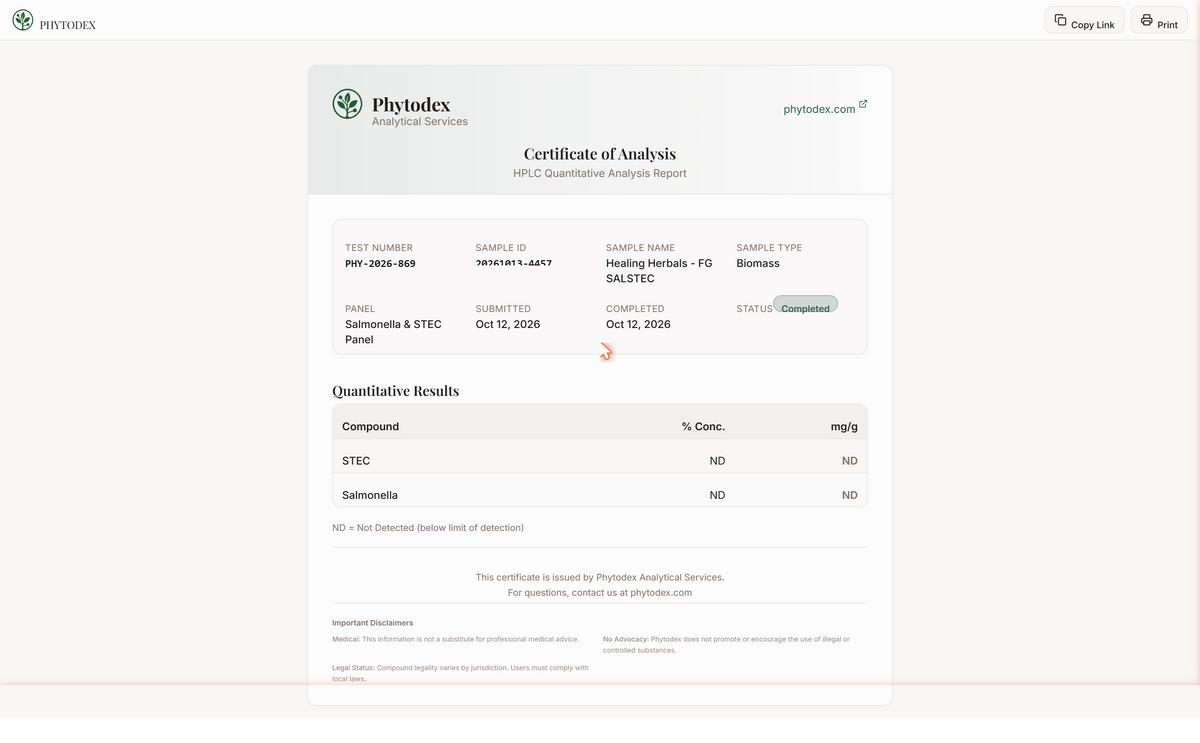
This is the second contaminant report in the series and the companion to the pesticide panel. Same field grown kanna leaf, same lab, same completion date. This one screens for two groups of bacteria, Salmonella and STEC, and reports both as not detected.

The report at a glance
- Product: Field Grown Kanna Leaf, listed in our shop as Milled / Powderized Kanna Leaf (Field Grown)
- Lab: Phytodex, an independent US lab
- Report number: PHY-2026-869
- Sample ID: 20261013-4457
- Completed: October 12, 2026
- Panel: Salmonella and STEC Panel
- Result: Salmonella not detected, STEC not detected
What was tested
The sample is our field grown Sceletium tortuosum leaf, the same material covered by pesticide report PHY-2026-868. The card on our Lab Results page links this report to the milled leaf powder. It does not say whether the lab received the leaf milled or whole, so we will not say either.
The panel name tells you the two targets. Salmonella is a genus of bacteria. STEC stands for Shiga toxin-producing Escherichia coli, a group of E. coli strains defined by the toxin genes they carry. Botanical labs commonly screen dried plant material for both as part of a microbial panel.
The card does not state the analytical method or the sample mass the lab tested. Both are normally printed on the full certificate, so check the lab's share page below if you want them.
Reading a presence or absence result
A potency report gives you a number for every line, then adds them into a total. A pathogen screen like this one works differently. Each target gets one of two answers: detected or not detected. There is no percentage, no milligrams per gram, and no total to compute.
Not detected, often printed as ND, means the test did not find the target in the portion of sample the lab analyzed. It is a statement about that portion, run by that method, on that date. It is not a promise about material that was never tested, which is why every report is tied to a sample ID.
Some reports use "below LOQ" instead, which means a trace may be visible but sits under the lowest level the lab will quantify. That wording mostly shows up on numeric tests. On a detected or not detected screen like this one, you will see ND.
Two reports, one batch of leaf
The sample IDs run back to back: 20261013-4456 for pesticides and 20261013-4457 for this microbial screen. Both start with October 13, 2026 and both list a completion date of October 12, 2026. We report the dates as the card shows them. If the order looks odd, the lab's share page has the dates as printed on the certificate.
Put together with our earlier potency report on the leaf, PHY-2026-786, the leaf now has three independent reports on the page: alkaloids, pesticides and pathogens.
Matching your bag to this report
Look for the batch or report number on your bag or packing slip. If it matches PHY-2026-869 or its pesticide partner PHY-2026-868, these are your reports. If your bag shows a different number, email herbalhealingsmarketing@gmail.com and we will send the matching certificate.
Verify it yourself
Verify PHY-2026-869 on Phytodex. The lab hosts that page, not us. Check that the report number, sample ID, panel name and both results match the image above.
Every report we have posted is on the Lab Results page. If certificates are new to you, read How to read a botanical lab report first.
Healing Herbals (Holistic Plant Remedies LLC) grows and extracts its own kanna in South Africa and tests with independent US labs.
Lab results are provided for information only and apply to the tested sample. For adults 21 and over. These statements have not been evaluated by the Food and Drug Administration. This product is not intended to diagnose, treat, cure, or prevent any disease. Traditional use of a botanical does not establish that it will produce any particular result. Keep out of reach of children.
Leave a comment
This site is protected by hCaptcha and the hCaptcha Privacy Policy and Terms of Service apply.