

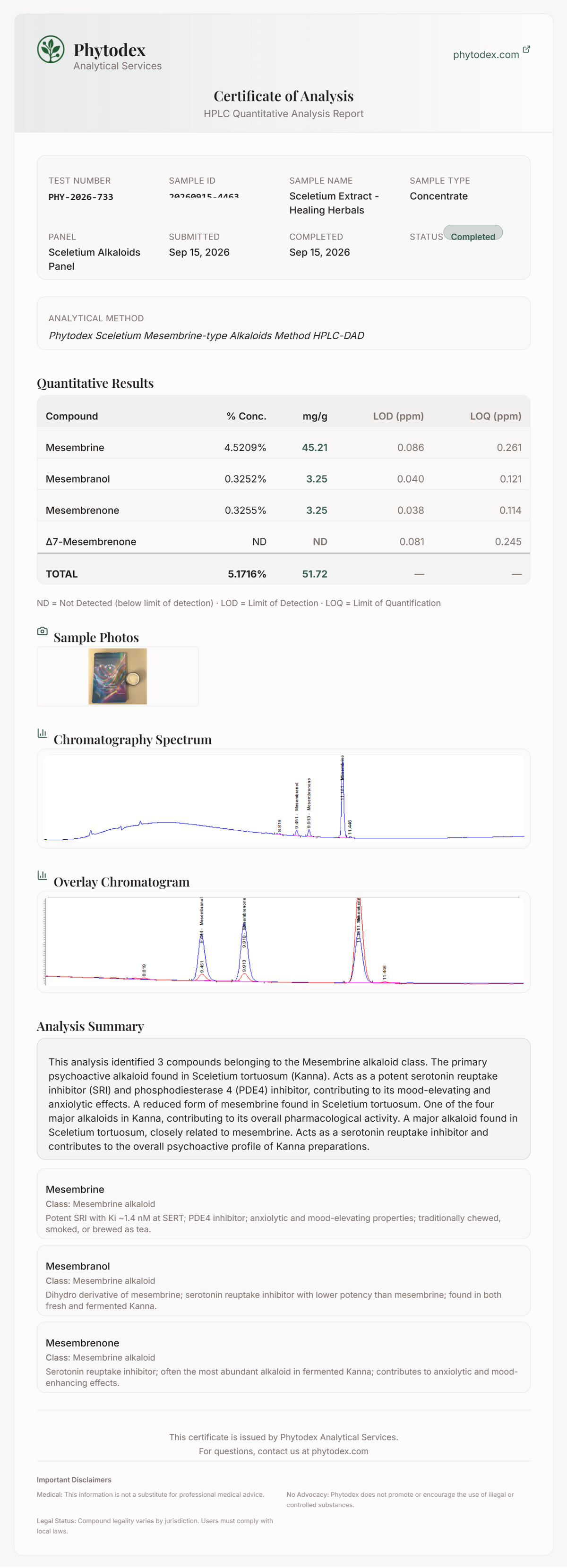
Lab Results: MT5 BLOOM Kanna Extract, Report PHY-2026-733 (5.17% Total Alkaloids)
Second post in the Lab Results series. This one covers MT5 BLOOM, a kanna extract, and it is a good report for learning how the individual alkaloid lines add up to a total, because the card on our Lab Results page shows the breakdown.

The report at a glance
- Product: MT5 BLOOM Kanna Extract
- Lab: Phytodex (independent, United States)
- Report number: PHY-2026-733
- Completed: September 15, 2026
- Mesembrine: 4.52%
- Mesembranol: 0.33%
- Mesembrenone: 0.33%
- Total alkaloids: 5.17%
The method
Same test as the rest of our kanna: a Sceletium alkaloids panel run by HPLC-DAD at Phytodex. Liquid chromatography separates the compounds in the extract, a diode array detector measures each one, and the lab quantifies them against reference standards. The output is a number for each alkaloid plus a sum.
Reading each line
Mesembrine at 4.52% is the largest line on this report by a wide margin. Mesembranol and mesembrenone each came in at 0.33%. These are three of the four alkaloids a kanna panel reports. The fourth, delta-7 mesembrenone, is not quoted on the card for this batch. For that line, read the certificate image or the lab's share page below rather than taking a number from us.
We are describing chemistry only. These posts are about what is in the jar and how it was measured, not what any compound does.
How the total is computed
Add the lines. 4.52 plus 0.33 plus 0.33 equals 5.18, and the report states 5.17%. The one hundredth of a percent difference is rounding. Each individual line is rounded to two decimal places before it is printed, while the lab sums the unrounded values. You will see this on almost every multi-line potency report from any lab, and it is normal. If the gap were a full percent or more, that would be a question worth asking.
In mg per gram, 5.17% is 51.7 mg of total alkaloids per gram of extract. Mesembrine alone is 45.2 mg per gram.
What this report does not say
This is a potency panel. It does not include heavy metals, microbials or pesticides. Those are different tests. We say this in every post so nobody reads a potency number as a contaminant pass.
Matching your jar to this report
Check the batch or report number on your label or packing slip. PHY-2026-733 means this report is yours. A different number means a different run, and we will send you that certificate if you email herbalhealingsmarketing@gmail.com with the number.
Verify it yourself
Open the lab's own record: Verify PHY-2026-733 on Phytodex. The report number, date and all four figures should match what you see above. A screenshot can be edited. A page hosted by the lab cannot be edited by us, which is why we link it.
Product page: MT5 BLOOM Kanna Extract. Every report we have posted lives on the Lab Results page. New to reading these? Start with How to read a botanical lab report.
Healing Herbals (Holistic Plant Remedies LLC) grows and extracts its own kanna in South Africa and tests finished products with independent US labs. Every report we post lists a batch, lot or report number so you can match it to what is in your hands.
Next up: our field grown kanna leaf, report PHY-2026-786, where the numbers are much smaller and the mg per gram conversion earns its keep.
Lab results are provided for information only and apply to the tested batch. These statements have not been evaluated by the Food and Drug Administration. This product is not intended to diagnose, treat, cure, or prevent any disease. For adults 21 and over only.

Written by Herbal Healings
Leave a comment
This site is protected by hCaptcha and the hCaptcha Privacy Policy and Terms of Service apply.