
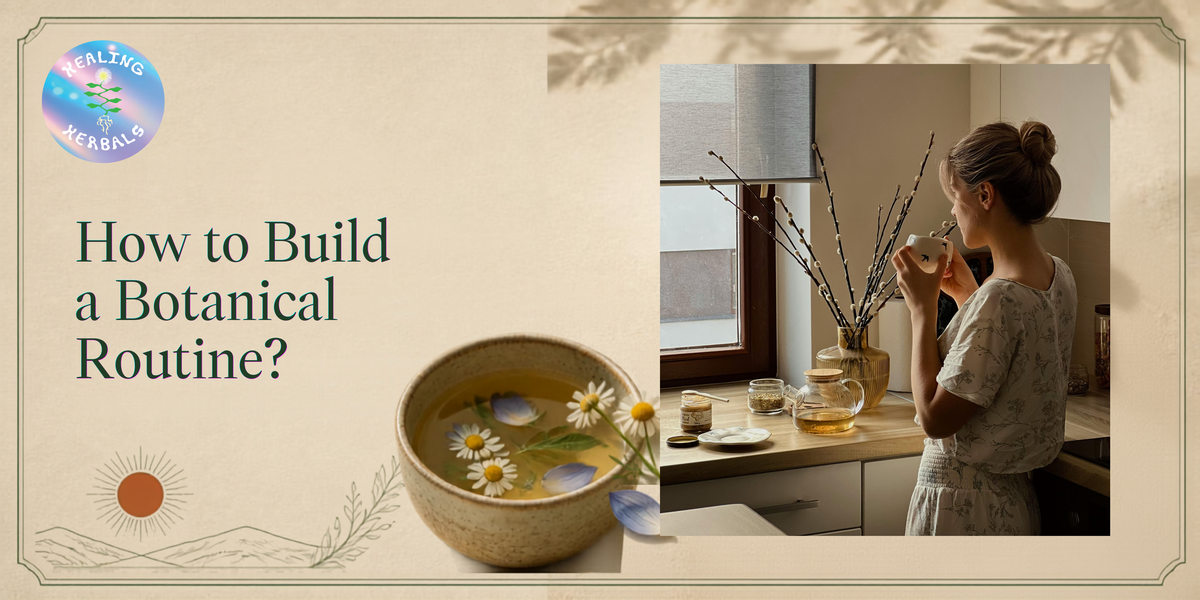
How to Build a Botanical Routine You'll Actually Stick With
TL;DR: A routine that lasts starts with one botanical and one preparation you look forward to, in a slot in your day where it fits. Mornings favor simple preparations, and evenings suit slower rituals like tea.
Most people start the same way. They read a few articles, get curious, and order five different botanicals at once. Three weeks later, the cabinet is full, the enthusiasm is gone, and they can't tell you which one they actually liked. You don't need a shelf full of herbs to build something meaningful. You need one botanical, one preparation you look forward to, and a slot in your day where it fits without a fight.

This guide walks through how to choose botanicals, compare formats, introduce them gradually, and build a routine that feels natural instead of forced.
What a Personalized Botanical Routine Actually Is
It's a consistent way of working herbs into your everyday life, shaped around your preferences instead of someone else's protocol. Unlike a rigid regimen, nobody has to use the same herb at the same hour. One person loves whole-herb infusions and the ten minutes of preparation that come with them. Another wants a tincture they can drop into water on the way out the door. Both are valid routines.
Yours will be shaped by:
- Your daily schedule
- The flavors and aromas you enjoy
- How much preparation you find relaxing versus tedious
- Whether you lean traditional or convenient
- How familiar you already are with a given botanical
- Why you're bringing botanicals into your life in the first place
- How you personally respond to a particular product
The goal isn't to collect botanicals. It's to build a real relationship with the few that fit your life.
Start With Your Daily Rhythm
Before you choose a single herb, look at when it would realistically happen.
A routine that needs twenty minutes of morning preparation sounds lovely in writing and collapses the first time you oversleep. Work with the habits you already have.
Morning favors simple preparations: herbal tea, botanical-infused beverages, aromatic herbs, quick powdered mixes. If you already boil water every morning, attaching a botanical to that existing ritual is far easier than inventing a new one.
Afternoon is a transition point between work, errands, exercise, and whatever comes next. It's a natural window for a different beverage or format, especially if you enjoy experimenting.
Evening routines tend to be slower and more deliberate. Tea, traditional botanical beverages, and aromatic preparations all fit into a broader wind-down.
One thing worth saying plainly: the ritual around the botanical matters as much as the botanical. Dimmed lights, a book, music, a stretch, putting the phone in another room that's the part doing most of the work.
Decide What You Want From the Ritual
"Botanical routine" means wildly different things to different people. So don't start with an herb. Start with the experience.
Maybe you want to swap out some of your usual drinks. Build a more intentional morning. Try herbs with real cultural history behind them. Add range to a tea collection. Host a gathering that doesn't revolve around alcohol. Make your evenings feel like they have an actual ending.
This step matters because it stops you from buying a botanical purely because it's trending.
Start with the ritual. Then choose the botanical.
Choose Botanicals Based on Their Character
Not every botanical plays the same role. Some are compelling for flavor, some for history, some for aroma, some for the way they're traditionally prepared.
Kava carries centuries of traditional use across Pacific Island cultures, where preparation and sharing were central to social and ceremonial life. It's earthy, slightly bitter, and unmistakable the flavor is part of the point. If you like a beverage with ceremony attached, kava is the obvious starting place.
Kanna (Sceletium tortuosum) is a South African succulent with a long history of traditional use, and it's the most format-diverse botanical on this list. You'll find powders, extracts, tinctures, gummies, and nasal preparations, and they are genuinely not interchangeable. Concentration and composition vary considerably between them, which makes reading the product page non-negotiable here.
Blue Lotus (Nymphaea caerulea) appears throughout ancient Egyptian art and turns up today as dried flowers, teas, tinctures, and extracts. It's floral, a little honeyed, faintly earthy underneath. If you like a fragrant cup and a slow evening, this is the one to try first.
Chamomile
The familiar entry point. Mild, gently floral, forgiving if you over-steep it, and available everywhere. There's no shame in starting here a routine you'll repeat beats an exotic one you won't.
Choose based on character and preference, not on what's popular this month.
Understand Whole Herbs, Powders, Extracts, and Tinctures
The most common beginner mistake is treating every product as equivalent. They aren't. The same plant behaves very differently depending on processing.
Whole herbs are closest to the original plant material and suit teas, infusions, and traditional preparations.
Powders are finely processed plant material convenient for mixing into drinks.
Extracts are produced by concentrating certain constituents, and strength varies significantly with extraction method. One gram of extract is not comparable to one gram of whole herb. This is the single most important sentence in this article.
Tinctures are liquid preparations designed for measured use, ideal if you don't want to brew anything.
Gummies are pre-portioned and easy, for people who'd rather not measure or steep.
Pick the format that matches your actual life. Convenience isn't a compromise. It's what makes a routine survive past week two.
Build Around Preparation, Not Just Ingredients
Consider the difference between swallowing a capsule and spending five minutes making tea. Neither is better. They're different rituals, and one of them might be the part you look forward to.
- Tea ritual: boil → prepare herbs → steep → sit down → enjoy
- Beverage ritual: prepare botanical mixture → add your preferred ingredients → serve warm or over ice
- Tincture ritual: measure per the product directions → add to your drink of choice
- Social ritual: prepare a shared botanical beverage → pour for friends → let the conversation run
The best preparation is the one you'll want to repeat tomorrow.
A Simple Morning Routine
It doesn't need to compete with the rest of your schedule.
Wake up → water → herbal tea → breakfast → begin the day
Chamomile, Lemon Verbena, or other traditional tea herbs work well here. The focus is flavor, aroma, and consistency not drama.If you currently reach for coffee the second your feet hit the floor, don't try to replace that overnight. Introduce a botanical tea on two mornings a week and see whether you look forward to it.
Build an Afternoon or Social Ritual
Botanicals don't have to be solitary. Across cultures, plants have been woven into communal drinks, hospitality, and ceremony for centuries.
Kava is the clearest example. Traditional kava culture shows how a botanical beverage becomes the center of a social occasion rather than something consumed privately for a specific outcome.
Modern botanical beverages slot naturally into gatherings, game nights, creative sessions, outdoor afternoons, and alcohol-free social occasions. That's a large part of why botanical culture has grown well beyond the herbal tea aisle.
Build an Evening Ritual
Evening is where a botanical routine has the most room to breathe. Instead of treating the herb as an isolated product, build a sequence around it.
Dinner → lower the lights → prepare tea → phone in another room → read or listen to music
Blue Lotus, Chamomile, Lavender, and Lemon Verbena all fit different versions of this, depending on preparation and taste. The value here isn't a promised outcome. It's having a consistent line between the busy part of the day and the quiet part.
Don't Start With Five Botanicals at Once
More isn't better. Introduce several products at once and you'll have no idea which one you actually liked.
One botanical, or one new format, at a time. Then pay attention to:
- Flavor
- Aroma
- Preparation
- Convenience
- Your personal experience
- The serving instructions
- How well it fits your schedule
Give each one enough time to earn its place. This matters most with concentrated extracts, where potency, extraction method, and serving size vary substantially between products follow the manufacturer's directions rather than your instincts.
Keep a Botanical Journal
No spreadsheet required. A phone note is enough.
|
What to Track |
Example |
|
Botanical |
Blue Lotus |
|
Format |
Dried flower |
|
Preparation |
Herbal infusion |
|
Time |
Evening |
|
Flavor |
Floral, earthy |
|
Amount |
According to product directions |
|
Experience |
Personal observations |
|
Would I use it again? |
Yes / No |
After a month of this, you'll have something better than memory: a personal reference guide showing which flavors, formats, and rituals genuinely suit you.
Know When to Change It
Your schedule will change. Your taste will change. You may discover you prefer tea to tinctures, or whole flowers to extracts. You're not obligated to keep using something because it was once part of your routine.
Every so often, ask:
- Do I still enjoy this?
- Is the preparation still convenient?
- Does it fit naturally into my day?
- Am I using it because I like it, or because it's become automatic?
These questions keep a routine intentional instead of turning it into one more obligation.
Three Routine Styles to Start From
The Minimalist. One botanical, one preparation. A favorite tea, same time every day. Simple, repeatable, hard to abandon.
The Ritual Builder. Different experiences across the day herbal tea in the morning, a botanical beverage in the afternoon, a floral infusion at night. Best for people who enjoy variety and the act of preparing.
The Social Botanical Enthusiast. Built around shared experiences. A botanical beverage at dinners, gatherings, game nights, and alcohol-free occasions. Less about ingredients, more about hospitality and conversation.
Find yourself in one of those three and you already know what to buy first.
Your Routine Doesn't Need to Be Complicated
Start with your schedule. Choose flavors and formats you actually enjoy. Learn the difference between whole herbs and concentrated extracts. Add one thing at a time, follow the directions, and keep notes.
Then let it evolve. A good botanical routine isn't a checklist. It's a personal practice built from curiosity, consistency, responsible use, and a real appreciation for plants.

Written by Herbal Healings

Leave a comment
This site is protected by hCaptcha and the hCaptcha Privacy Policy and Terms of Service apply.