Kanna vs Kratom: What’s the Difference?
Last updated: September 30, 2026
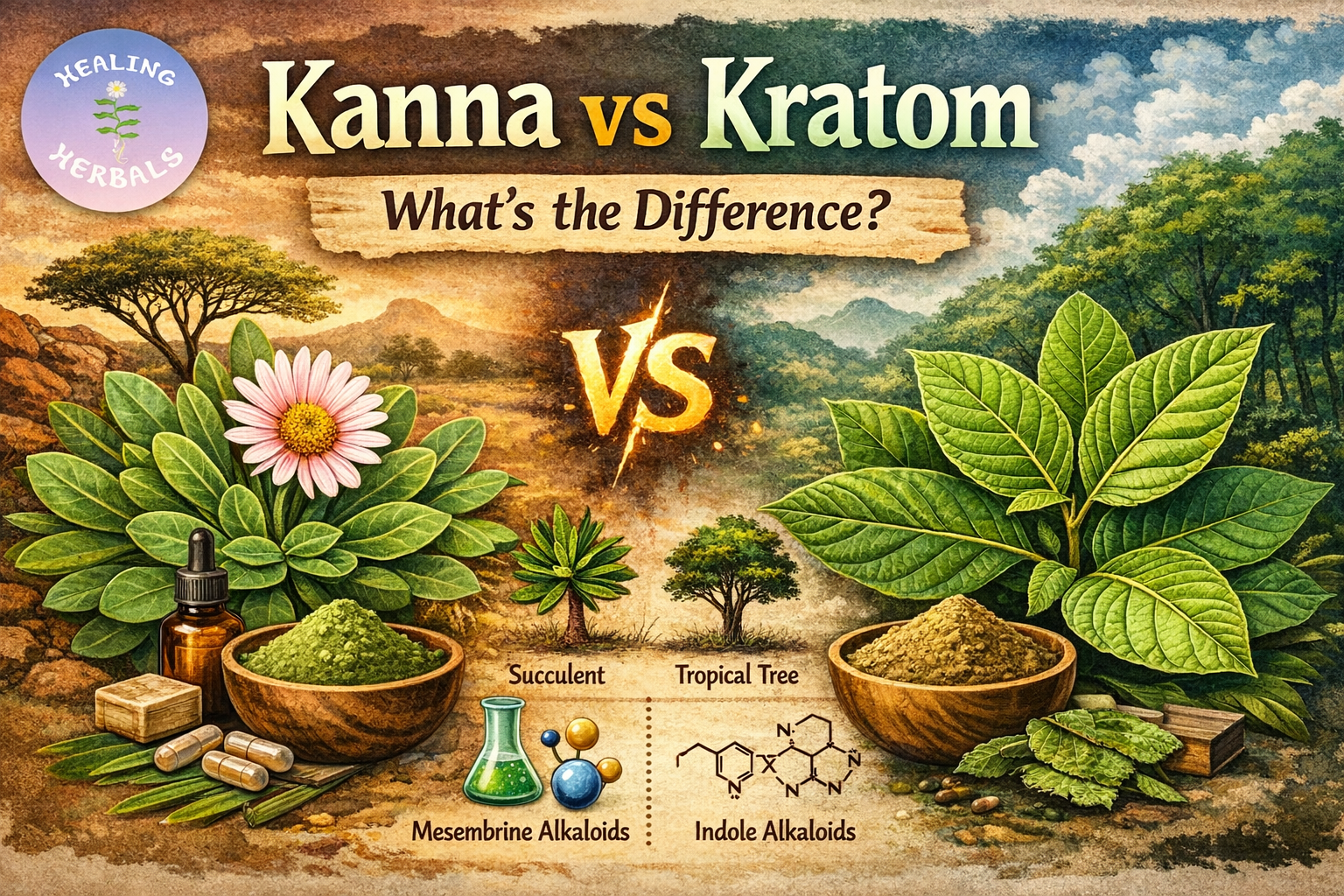
TL;DR: Kanna and kratom get compared constantly online, and they have almost nothing in common. Kanna is a fermented South African succulent whose alkaloids act on serotonin pathways. Kratom is a Southeast Asian tree in the coffee family whose alkaloids act on opioid receptors. Kanna extract is measured in milligrams, kratom leaf in grams. Kanna is unscheduled everywhere in the US; kratom is banned in six states and the FDA says it is not lawfully marketed as a supplement. The table below covers the rest.
If you spend time on botanical forums, one comparison comes up again and again: kanna vs kratom. The two get lumped together because they are sold by the same shops, discussed in the same threads, and searched by the same curious people. Botanically, chemically and legally, they are as different as coffee and cactus. This post breaks down where each plant comes from, what is in it, what people report, and where the law stands.
Kanna vs kratom at a glance
| Kanna | Kratom | |
|---|---|---|
| Plant | Sceletium tortuosum, a low-growing succulent | Mitragyna speciosa, a tropical evergreen tree in the coffee family |
| Origin | Namaqualand and Karoo regions of South Africa | Thailand, Malaysia, Indonesia, Papua New Guinea |
| Active compounds | Mesembrine, mesembrenone, mesembrenol, mesembranol (about 25 alkaloids in four classes) | Mitragynine, 7-hydroxymitragynine, speciofoline and 40 or more related indole alkaloids |
| How they act | Serotonin reuptake inhibition, some PDE4 inhibition | Partial agonists at the mu-opioid receptor |
| Legal status (US, 2026) | Unscheduled federally and in all 50 states | Unscheduled federally, banned in AL, AR, IN, RI, VT, WI; FDA says not lawfully marketed as a supplement |
| Effects people report | Mood lift, social ease, calm focus; heavier profiles described as relaxing | Stimulating at low amounts, sedating and pain-dulling at higher amounts |
| Duration | 2 to 3 hours insufflated, 4 to 6 hours oral or sublingual | Commonly reported 3 to 6 hours oral |
| Forms | Extract powder (1.5% to 24%), fermented leaf, tincture, nasal spray, vape, gummies, capsules | Dried leaf powder, capsules, tea, liquid shots, extracts |
| Typical serving | 25 to 200 mg of extract (roughly 2 to 20 mg alkaloids) | 2 to 8 grams of leaf powder |
| Price range | About $10 to $25 per gram of extract; about $0.50 to $1.50 per serving | About $10 to $30 per 100 g of leaf; about $0.50 to $2 per serving |
Where kanna comes from

Kanna is a succulent native to the dry western interior of South Africa. It grows a few inches off the ground, stores water in fat leaves, and survives on almost no rain. The Khoi and San peoples of the region chewed, smoked and brewed it for centuries, and their standard preparation was to crush the plant, seal it in a bag or hide for several days to ferment, then dry it. That fermentation step still matters; it shifts the alkaloid profile and is why "fermented kanna" means something specific to people who use it.
A 2022 review in the Journal of Ethnopharmacology catalogued 25 alkaloids across four structural classes in the plant, with the mesembrine group doing most of the work (Olatunji et al., 2022). Raw leaf runs roughly 0.3% to 2.3% total alkaloids. Modern kanna extract concentrates that to anywhere from 1.5% to 24%, which is why serving sizes are quoted in milligrams and why a scale is a good idea above 10%.
Today most commercial kanna is grown on farms in the Western and Northern Cape rather than wild-harvested. Healing Herbals grows on a leased nursery in South Africa with its own extraction lab, which is how we tie a lot number to a specific field.
Where kratom comes from

Kratom is the leaf of a tree that grows 30 to 80 feet tall in the wet lowlands of Thailand, Malaysia, Indonesia and Papua New Guinea. It belongs to the coffee family, which already puts it about as far from a desert succulent as a plant can get. Farm laborers in the region chewed fresh leaves or brewed them as tea to get through long days, and the plant has a long record of use for that purpose (Halpenny, 2017).
Almost all kratom sold in the US is dried, milled leaf from Indonesia. Unlike kanna, it is rarely extracted for consumer use; the leaf itself is the product, and it is dosed by the gram.
The chemistry is completely different
This is the part that settles the comparison. Kanna's main alkaloids, mesembrine and mesembrenone, are described in the research as serotonin reuptake inhibitors with a secondary action on the PDE4 enzyme. The plant's whole reputation as a mood and social botanical follows from that.
Kratom's main alkaloids, mitragynine and 7-hydroxymitragynine, are partial agonists at the mu-opioid receptor. A 2020 study in Scientific Reports that analyzed more than 50 commercial kratom products found the two alkaloids activate the G-protein signaling path with no measurable beta-arrestin recruitment, and noted that all three major alkaloids inhibit cytochrome P450 enzymes, which matters for anyone on medication (Todd et al., 2020).
Serotonin transporter on one side, opioid receptor on the other. There is no overlap in mechanism, which is why one plant is discussed as a social lift and the other as a pain and energy plant. It is also why the safety conversations around each are so different.
What people report
Kanna. The most common description is a shift in mood and mental atmosphere rather than a heavy effect: easier conversation, music sounding better, a calm sort of focus. Mesembrine-leaning extracts are described as bright and social; mesembrenone-leaning ones as heavier and more relaxing. Onset is 5 to 15 minutes sublingually, faster by nose, 30 to 60 minutes in a capsule. Most people put the window at 4 to 6 hours orally. A 3 month placebo-controlled trial of a standardized extract at 8 and 25 mg a day reported it was well tolerated in healthy adults, with headache the most common complaint and more of it in the placebo group (Nell et al., 2013).
Kratom. Users describe a stimulant-like lift at 1 to 3 grams and a sedating, pain-dulling effect at 5 grams and up, lasting 3 to 6 hours. Regular daily use is widely reported to lead to physical dependence and a withdrawal syndrome, which is the main reason the plant draws regulatory attention that kanna does not.
Legal status in 2026
Kanna is not scheduled under the Controlled Substances Act, and no US state has restricted it. It is sold as a botanical and shipped to all 50 states. Some countries, including parts of the EU, treat it differently, so check before traveling.
Kratom is more complicated. It is not federally scheduled; the DEA announced an intent to schedule its alkaloids in 2016 and withdrew after public pushback (Halpenny, 2017). Six states ban it outright: Alabama, Arkansas, Indiana, Rhode Island, Vermont and Wisconsin. A growing list of states regulate it under Kratom Consumer Protection Acts with age limits and labeling rules, and several counties and cities have their own bans. The FDA's position, updated December 2025, is that kratom is not lawfully marketed as a drug, dietary supplement or food additive, and it warns about liver toxicity, seizures and dependence (FDA, 2025). Healing Herbals does not sell kratom on this site.
Dose scale and price
A single kanna serving is a pinch. Fifty milligrams of a 5% extract carries about 2.5 mg of alkaloids; the same 50 mg of a 20% extract carries 10 mg. A gram of extract at $10 to $25 lasts most people 10 to 30 servings, so the per-serving cost lands around $0.50 to $1.50. Our own range runs from MT5 Bloom at 5% to 24%, with sprays, gummies and pre-rolls for people who do not want to handle powder.
A single kratom serving is a spoon. Two to eight grams of leaf powder, usually stirred into juice or swallowed in capsules. A 100 g bag at $10 to $30 gives 15 to 40 servings, so the math ends up similar per dose even though the quantities look nothing alike.
Can you combine them?
People do, and forums are full of reports. We do not recommend it. Kanna works on serotonin; kratom works on opioid receptors and inhibits liver enzymes that clear other compounds. Nobody has studied the combination, and stacking two active botanicals with different mechanisms is a way to learn something the hard way. If you want to try kanna, try it alone first at a low percentage and see how your body responds.
Bottom line
Kanna and kratom share a shelf and a search results page. That is the whole overlap. Different continents, different plant families, different alkaloids, different receptors, different legal treatment, different dose scale. If you came here trying to decide which one you were looking for: kanna is the social, mood-forward succulent measured in milligrams. Kratom is the energy-and-pain tree leaf measured in grams. Full lot-tested kanna options are in the kanna extract collection.
Sources
- Olatunji TL et al. Sceletium tortuosum: a review on its phytochemistry, pharmacokinetics, biological, pre-clinical and clinical activities. J Ethnopharmacol. 2022. sciencedirect.com
- Nell H, Siebert M, Chellan P, Gericke N. A randomized, double-blind, parallel-group, placebo-controlled trial of extract Sceletium tortuosum (Zembrin) in healthy adults. J Altern Complement Med. 2013. journals.sagepub.com
- Halpenny GM. Mitragyna speciosa: balancing potential medical benefits and abuse. ACS Med Chem Lett. 2017. PMC5601368
- Todd DA et al. Chemical composition and biological effects of kratom (Mitragyna speciosa): in vitro studies with implications for efficacy and drug interactions. Sci Rep. 2020. PMC7645423
- US Food and Drug Administration. FDA and Kratom. Updated December 2025. fda.gov
These statements have not been evaluated by the Food and Drug Administration. These products are not intended to diagnose, treat, cure or prevent any disease. This article is for informational purposes and is not medical advice. For adults 21 and over only.
Learn more about kanna:

Written by Herbal Healings


Leave a comment
This site is protected by hCaptcha and the hCaptcha Privacy Policy and Terms of Service apply.