Article: Lab Results: Field Grown Kanna Leaf, Report PHY-2026-786 (1.14 mg/g Total Alkaloids)
Lab Results: Field Grown Kanna Leaf, Report PHY-2026-786 (1.14 mg/g Total Alkaloids)
Third post in the Lab Results series, and the first one on raw plant material instead of an extract. This is our field grown kanna leaf, sold as loose leaf. The report is the newest one on our page.

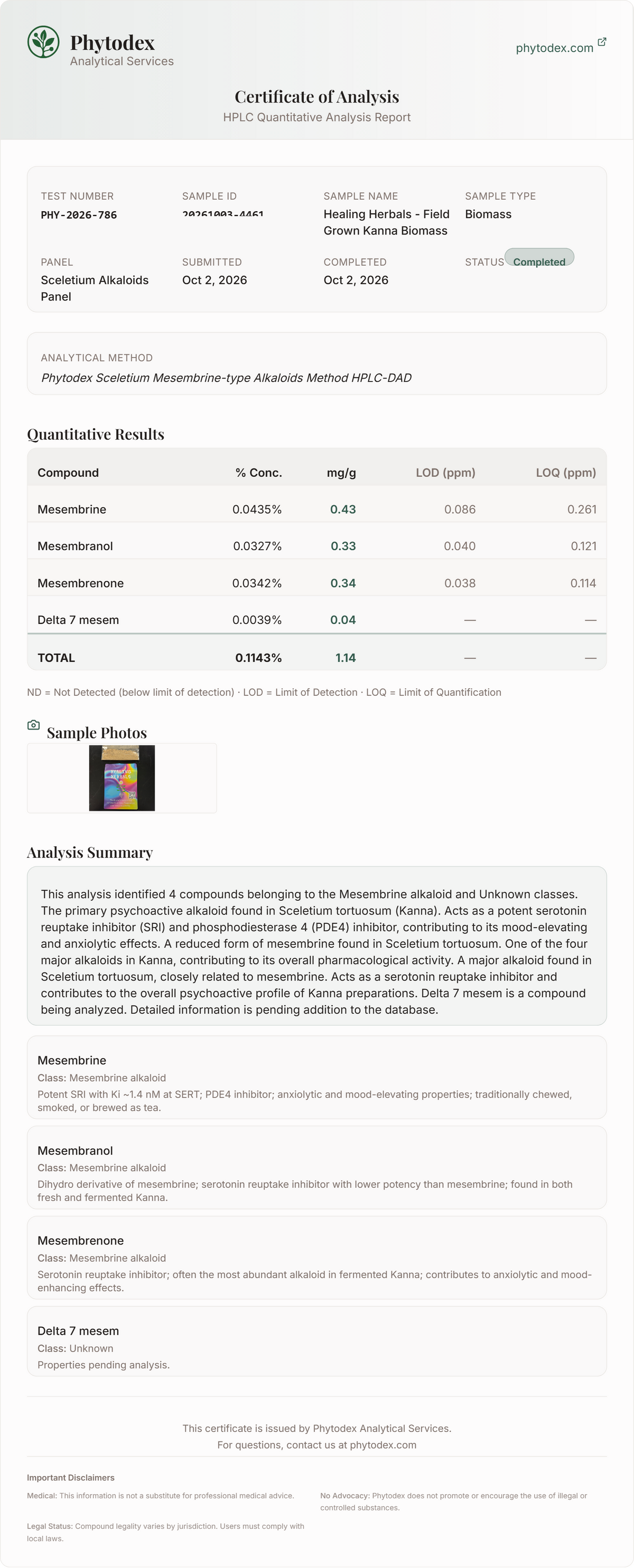
The report at a glance
- Product: Field Grown Kanna Leaf (loose leaf)
- Lab: Phytodex (independent, United States)
- Report number: PHY-2026-786
- Sample ID: 20261003-4461
- Completed: October 2, 2026
- Panel: Sceletium Alkaloids Panel, HPLC-DAD
- Mesembrine: 0.0435%
- Mesembranol: 0.0327%
- Mesembrenone: 0.0342%
- Delta-7 mesembrenone: 0.0039%
- Total alkaloids: 0.114% (1.14 mg/g)
Leaf versus extract
If you read the first two posts you saw totals of 6.14% and 5.17%. This one is 0.114%. That is not a typo and it is not a bad batch. It is dried leaf, not a concentrated extract, and our growing and drying process is what it is. An extract is made by pulling the alkaloids out of a lot of leaf and concentrating them into a little powder. Raw leaf has whatever the plant grew. A fifty-fold difference between leaf and a strong extract is the kind of gap you should expect.
Reading the four lines
This report has all four alkaloids above the quantitation limit, which makes it a clean example of a full panel. Mesembrine 0.0435%, mesembranol 0.0327%, mesembrenone 0.0342%, delta-7 mesembrenone 0.0039%. Notice the lab printed four decimal places here instead of two. When the numbers are this small, two decimals would round most of them to 0.03 or 0.04 and hide the differences, so the lab reports more digits.
In raw leaf the three main alkaloids are closer to each other in size than they are in our extracts, where mesembrine dominates. That is a feature of the plant material, not of the test.
How the total is computed
0.0435 plus 0.0327 plus 0.0342 plus 0.0039 equals 0.1143, which rounds to 0.114%. To get mg per gram, multiply percent by 10: 0.114% is 1.14 mg of total alkaloids per gram of leaf. The lab prints both so you do not have to do the math, and because mg per gram is the unit most people find easier to picture for leaf.
The sample ID
20261003-4461 encodes the intake date, October 3, 2026, and a running sample count. The completion date on the card is October 2, 2026. The card is reporting the dates as printed on the certificate, so if the ordering looks odd to you, open the lab's share page below and read the dates there directly.
Matching your bag to this report
Find the batch or report number on the bag or your packing slip. PHY-2026-786 means this is the report for your leaf. If your bag shows a different number, email herbalhealingsmarketing@gmail.com with it and we will send the matching certificate.
Verify it yourself
Verify PHY-2026-786 on Phytodex. The lab hosts that page, not us. Check that the report number, sample ID, panel name and all five figures match the image above.
Product page: Field Grown Kanna Leaf (loose leaf). Every report we have posted lives on the Lab Results page. New to reading these? Start with How to read a botanical lab report.
Healing Herbals (Holistic Plant Remedies LLC) grows and extracts its own kanna in South Africa and tests finished products with independent US labs. Every report we post lists a batch, lot or report number so you can match it to what is in your hands.
Next in the series we switch plants. Post four covers a kava product and a supplier lab report, which is read a little differently.
Lab results are provided for information only and apply to the tested batch. These statements have not been evaluated by the Food and Drug Administration. This product is not intended to diagnose, treat, cure, or prevent any disease. For adults 21 and over only.

Written by Herbal Healings

Leave a comment
This site is protected by hCaptcha and the hCaptcha Privacy Policy and Terms of Service apply.