Kanna Flowers
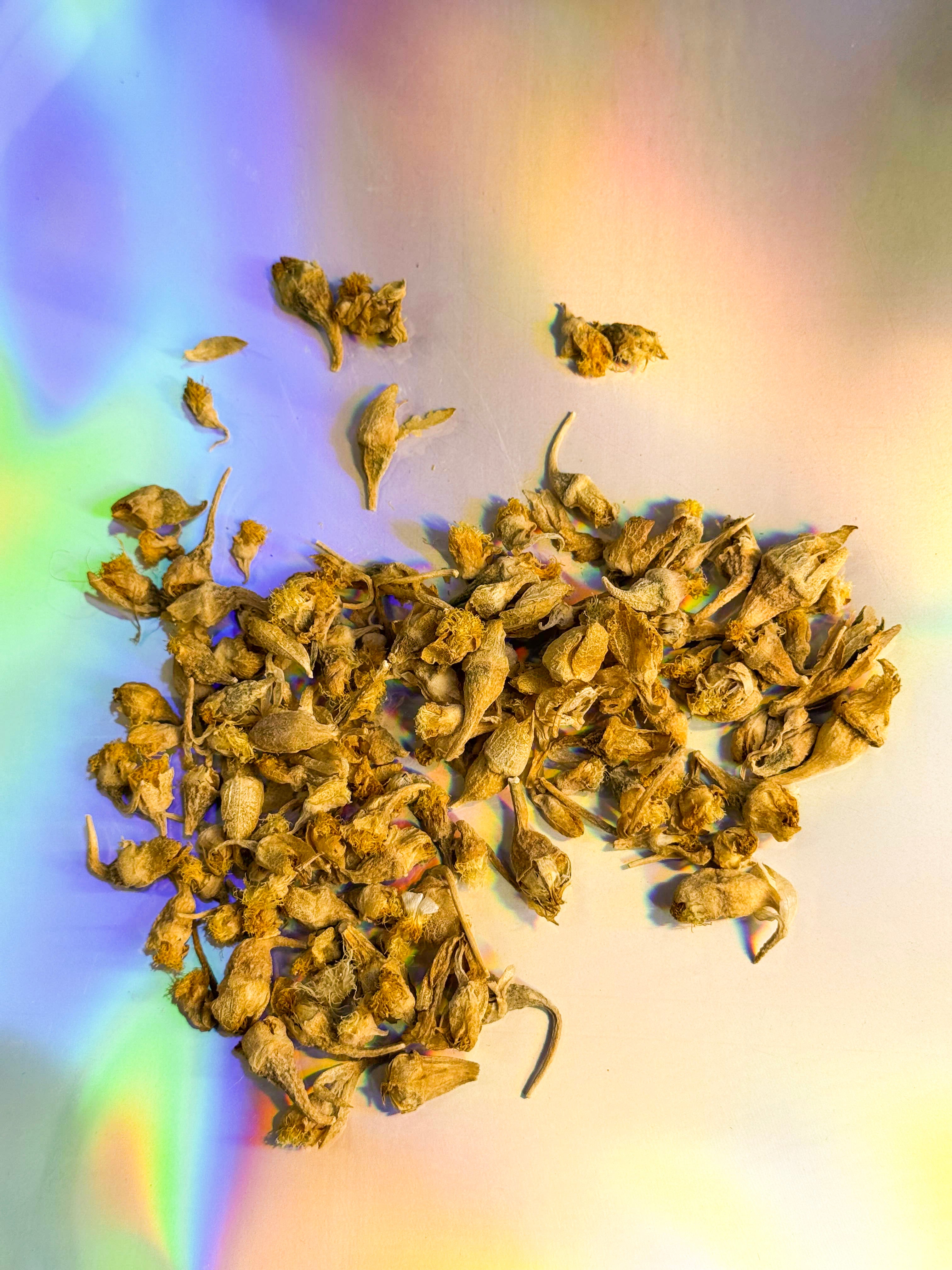
Kanna Flowers These are whole dried flowers of the kanna plant, Sceletium tortuosum, the pale yellow to white blooms of the perennial succulent, isolated and dried on their own instead of being milled into the leaf material. To our knowledge this is the first time whole kanna flowers have been offered to the public. They are grown in house under natural, organic growing practices using only plant-based nutrients such as kelp, and they are sold as a botanical specimen for research, incense and apothecary use in .5oz, 1oz, 2oz and kilo sizes. When my wife and I walked into the drying room at our kanna farm, the honeysuckle-like fragrance of the flowers was what we noticed first, and we decided they deserved to be dried whole and offered on their own. Our kanna is grown through benefit-sharing partnerships with the South African San Council, the traditional custodians of Sceletium knowledge.
At a glance
- Whole dried flowers of Sceletium tortuosum, pale yellow to white blooms
- To our knowledge the first time whole kanna flowers have been offered to the public
- Grown in house under organic practices with plant-based nutrients such as kelp
- Sold as a botanical specimen for research, incense and apothecary use
- Sizes: .5oz, 1oz, 2oz and kilo
- Shown to carry higher mesembrine, with a sweet honeysuckle-like fragrance
The herb. Kanna is a low, spreading succulent in the Aizoaceae family from the Karoo of South Africa. The San and Khoikhoi peoples chewed and fermented it for generations, and the name kanna comes from their word for the eland antelope. The flowers are the plant's reproductive part, and like the leaf, stem and root they carry kanna's alkaloids, mesembrine, mesembrenone, delta-7-mesembrenone and mesembranol, in a balance of their own.
What's in it. The listing does not state an alkaloid percentage for the flowers, so we do not quote one; what it states is that the flowers have been shown to carry higher amounts of mesembrine and may contain other rare, lesser-known alkaloids that the leaf does not. Mesembrine is the brighter, more uplifting alkaloid in kanna, while mesembrenone and delta-7-mesembrenone are the calmer, body-focused ones, so a mesembrine-rich flower leans toward the lifted end of the plant. The flowers also carry the aromatic compounds behind that honeysuckle scent, which is what makes them interesting as incense.
Dosage, first time. This is a botanical specimen and the listing gives no serving, so we do not suggest one. If you burn the flowers as incense, use a pinch on a charcoal disc or in a resin burner in a ventilated room and judge the scent before adding more. If you choose to work with them as a kanna material, begin with a small amount, wait a full two hours, and assess the whole effect before repeating.
Regular use. Most flower buyers are researchers, incense makers and apothecaries, and their use is occasional by nature. If you settle into a pattern with the flowers as a material, keep the amount small and consistent; a higher mesembrine reading is a reason for care, not for using more.
What to expect. As a specimen, expect small, light, papery blooms in pale yellow to white with a sweet, honeysuckle-like fragrance. As incense, users describe a soft, floral, faintly green smoke. As a material, a mesembrine-forward profile reads as bright, lifted and clear rather than heavy. The flowers suit researchers comparing plant parts, incense and perfume makers, and collectors building a full Sceletium set alongside our Kanna Roots. If you want to grow your own blooms, start with our Kanna Seeds.
Side effects. Every part of the kanna plant carries its alkaloids, and side effects follow the dose. Too much can bring mild nausea, a headache, a jittery feeling or a dip in appetite; reduce or stop, drink water and it passes as the kanna clears. Burned as incense, any smoke can irritate the throat, so keep the room ventilated.
Interactions and cautions.
- Do not combine kanna with SSRIs, SNRIs, MAOIs or other serotonergic medications, including triptans, tramadol and St. John's Wort, because of the risk of serotonin syndrome
- Do not use with alcohol
- Not for use if pregnant or nursing, or if you have a heart condition
- Sold as a botanical specimen; check your local laws
- For adults 21+ only, and keep out of reach of children
Ingredients and storage. Whole dried flowers of Sceletium tortuosum, grown in house with plant-based nutrients such as kelp, nothing added. Store in an airtight jar in a cool, dry, dark place; the blooms are delicate and lose their fragrance to light, heat and air, so open the jar only when you need them.
Common questions
- What do dried kanna flowers smell like? They carry a sweet fragrance reminiscent of honeysuckle.
- Are kanna flowers stronger than kanna leaf? The flowers have been shown to carry higher amounts of mesembrine and may hold other rare alkaloids, but no percentage is stated and they are sold as a specimen, not a dosed product.
- How are Healing Herbals kanna flowers grown? In house, under natural and organic practices, fed only with plant-based nutrients such as kelp.
Disclaimer. These statements have not been evaluated by the Food and Drug Administration. This product is not intended to diagnose, treat, cure, or prevent any disease. Kanna is a traditional botanical, and traditional use does not establish that it will produce any particular result. Consult your healthcare provider before use if you take any medication or have a medical condition. Use at your own risk and keep out of reach of children. Formulated by Healing Herbals, run by a practicing herbalist of 13+ years.
Choose options