
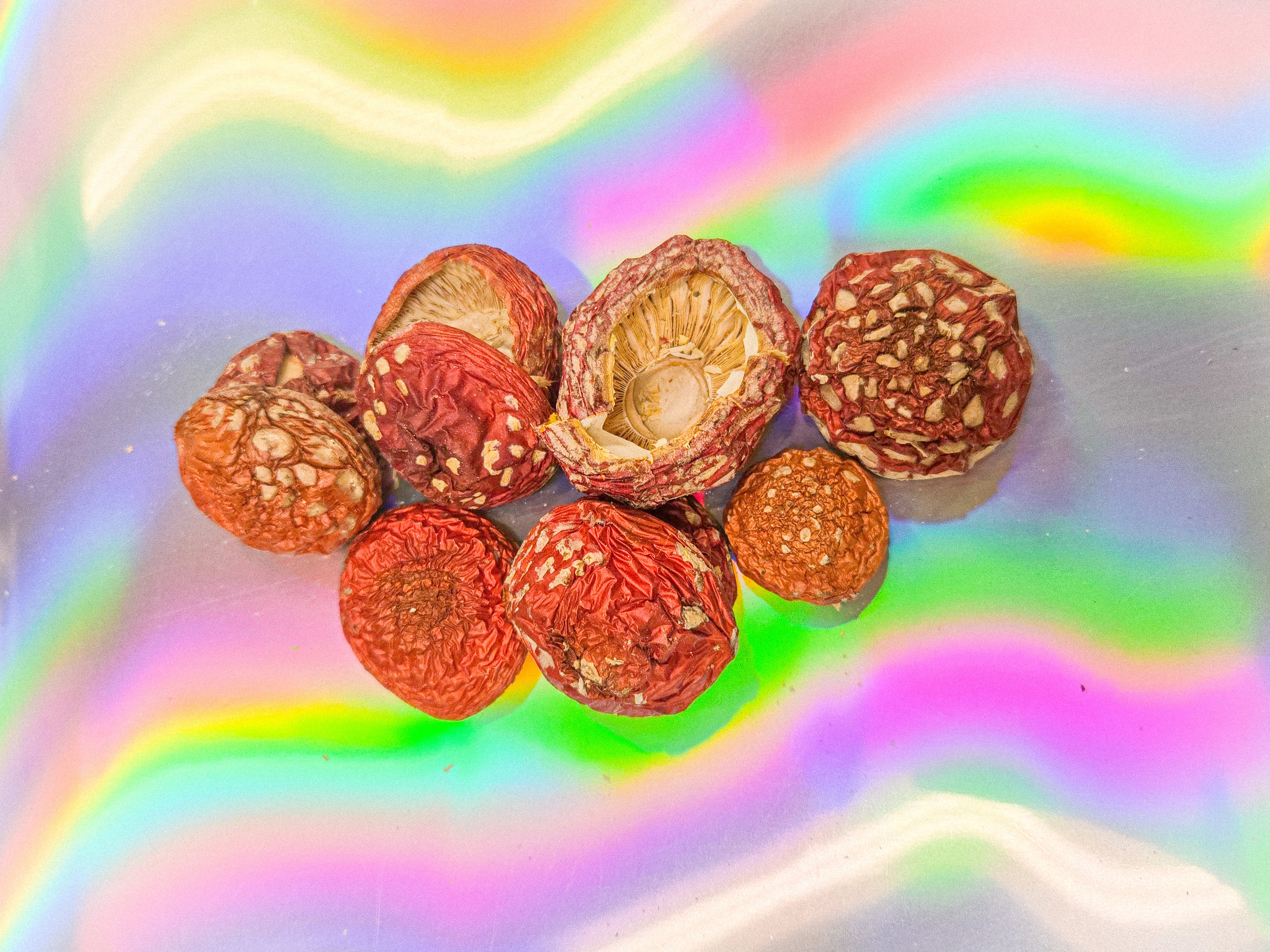
Amanita Muscaria Closed Caps (High Muscimol & Ibotanic acid)
You're on the list. We'll email you the moment it's back in stock.
Sold out right now. The closest thing we have in stock is our Amanita Muscaria Mushroom Caps (A-Grade), whole opened caps, HPLC tested, ready to ship. Drop your email below and we'll let you know when the closed caps are back.
Dried Amanita muscaria caps in their densest form: these closed caps are wild-harvested fly agaric buttons gathered from native forest floors during the autumn flush, picked before the red dome expands or the veil breaks, so the cap structure stays fully intact. Immediately after foraging, the mushrooms are sorted to remove dirt and debris, then uniform heat-dehydrated to a safe moisture level for long-term storage. Where an opened cap is thin and easy to break, a button is dense and holds its shape, and this is the specimen most people picture when they think of the fly agaric.
This product consists strictly of unexpanded, whole button caps rather than broken pieces or fully opened, flat canopies. They are offered as raw, unprocessed dried botanical specimens for historical research, mycological identification, educational study, and traditional ethnobotanical collections.
At a glance
- Wild-harvested Amanita muscaria buttons, picked before the veil breaks
- High muscimol and ibotenic acid, HPLC tested per batch
- Whole unexpanded caps only, no broken pieces or flat canopies
- Low-heat dehydrated, which holds the deep crimson colour
- Sizes from 2 grams to 2 oz
- Not for human consumption. Not shipped to Louisiana. Adults 21 and over
Why closed caps are a different product. A button is the same mushroom at an earlier stage. Before the dome expands, the flesh is dense, the white warts sit tight and even, and the whole structure holds its shape through drying. An opened cap is thinner, flatter and far easier to break. For anything where the specimen has to survive handling, a closed cap is the better material, and it is also the shape people recognise from illustration and folklore.
Traditional use. The fly agaric is the red-and-white mushroom of northern birch and pine forests, and the Koryak of Kamchatka and the Sámi of Lapland dried the caps before use, often strung by the fire or laid on stones. Drying was never decoration in those traditions. It was the step that changed the mushroom, and it is the reason a dried cap and a fresh cap are not the same thing. Fresh caps should never be eaten.
Compounds in the species.
- Muscimol: the principal compound in the species
- Ibotenic acid: the precursor, present in higher proportion in early-stage material and shifting toward muscimol as the material dries and ages
- Muscarine: trace amounts only, despite the shared name
Harvest and processing.
- Foraged from native forest floors during autumn flushes, not cultivated
- Sorted immediately after harvest to remove dirt and debris
- Uniform low-heat dehydration to a safe moisture level
- Batch inspected, with damaged pieces separated out before packing
- Each lot HPLC tested for muscimol and ibotenic acid before listing
How we test. Every lot of caps goes to HPLC before it is graded. Buttons carry more ibotenic acid than opened caps because they are picked younger, and the test is what tells us a lot is worth selling as closed caps rather than folding it into B-grade. We keep the foraging source private. Ask customer service if you want a batch result.
What they are used for. Microscopic evaluation, spore printing and comparative taxonomy, where an intact early-stage specimen gives a reliable reference point. Also display, photography and ethnobotanical collections, where the unbroken dome and even warts matter more than anything else.
Legality. Amanita muscaria is not federally scheduled in the United States. A few states restrict it, Louisiana most clearly, and we do not ship amanita there. Check your state and local rules before ordering. Adults 21 and over only.
Storage. Rigid sealed container rather than a bag, dark, dry, with a desiccant packet. Light dulls the crimson over months and humidity is what softens a button and then cracks it.
The rest of the amanita line. Opened caps are A-Grade and B-Grade. If you would rather skip preparation, the Amanita muscaria extract 15:1 is already converted and concentrated, and the muscimol isolate is the single compound on its own. Related species include Amanita pantherina caps and Amanita Regalis Closed Caps. Everything is in the Amanita muscaria collection.
Common questions
- What makes a closed cap different from an A-grade cap? Growth stage. Closed caps are buttons picked before the dome opens, so they are denser and hold their shape. A-grade caps are fully opened and sorted whole.
- Are these wild or cultivated? Wild-harvested from native forest floors during autumn flushes.
- Do closed caps carry more ibotenic acid than opened caps? Generally yes, because they are picked younger and less of it has converted to muscimol. That is why we test every lot rather than assume.
- Can I take a spore print from these? The intact structure is well suited to it, which is one of the main reasons people choose buttons over opened caps.
- How should I store them? Rigid sealed container, dark, dry, with a desiccant packet.
Disclaimer. Not for human consumption. These statements have not been evaluated by the Food and Drug Administration. This product is not intended to diagnose, treat, cure, or prevent any disease. Sold as a dried botanical specimen for research, identification, educational study and collections. Traditional use does not establish that it will produce any particular result. For adults 21 and over. Keep out of reach of children and pets.
Choose options
You're on the list. We'll email you the moment it's back in stock.